
Switching to an electric fleet is no longer a distant vision. Fleet electrification has become part of everyday operations for many companies. The key to success is not the vehicle alone, but the question of how you charge your company fleet reliably and cost-effectively. Companies that approach fleet electrification strategically keep their company fleet affordable and ready to go at all times.
Fleet electrification keeps gaining momentum. According to the Fleet Charging Study 2026 by Uscale, 56% of the companies surveyed are already pursuing a long-term electrification strategy. Just as telling: the share of businesses that cite high vehicle costs as an obstacle has fallen from 52% in 2024 to 29% in 2026. Fleet electrification is therefore moving from a special project to the centre of fleet strategy.
The reasons behind fleet electrification are clear. Electric vehicles lower operating costs per kilometre, improve the CO2 balance and strengthen a company’s image. On top of that comes growing pressure from sustainability targets and reporting obligations. Those who plan today gain a measurable head start on costs, image and climate goals.
Good to know: fleet electrification is not a one-off project but an ongoing process. In many fleets, 20% to 30% of vehicles are already suitable for an immediate switch, and the trend is rising. This is exactly where the success of fleet electrification is decided. Only the right charging infrastructure turns the switch into an economic gain.
Whether the switch succeeds depends above all on one question: how do you charge your company fleet reliably without slowing operations down? Successful businesses combine three building blocks. Which one dominates depends on your usage profiles, downtimes and routes. The right combination forms the core of every successful fleet electrification.
Depot charging is the backbone of most electric fleets. Your vehicles charge precisely when they are standing idle anyway, for example overnight at the depot. This creates predictable operations and low energy costs. It becomes especially cost-effective with fixed routes and long downtimes. Around 40% to 50% of heavy goods vehicles travel less than 300 km a day, a distance that is easily topped up overnight. Industry forecasts assume that by 2030 roughly two thirds of all charging will take place at the depot.
For the site you need a suitable grid connection, a well-planned electrical installation and intelligent load management. The latter distributes the available power dynamically across all vehicles and avoids costly peak loads. When downtimes are short or shifts change over, powerful DC charging points complement the AC solution so that individual vehicles are quickly ready for the road again.
Many employees with an electric company car prefer to charge at home. For companies this is attractive because it relieves the depot and offers drivers convenience. Since January 2026, an updated rule from the Federal Ministry of Finance sets out how businesses can reimburse home charging costs tax free. A transparent billing system ensures that every kilowatt hour charged is cleanly assigned to the right vehicle. This keeps home charging a cost-effective building block of your fleet electrification.
Not every company fleet returns to a central site in the evening. Field service, sales teams, care services and last-mile delivery move through the urban area all day. For them, commercial charging in the city is decisive. Public fast-charging points step in exactly where depot and home charging reach their limits: with short downtimes, high daily mileage and no depot of your own.
This gap is filled by a dense, reliable fast-charging infrastructure in the city centre. It turns short breaks, whether at a client, while shopping or over lunch, into valuable charging time.
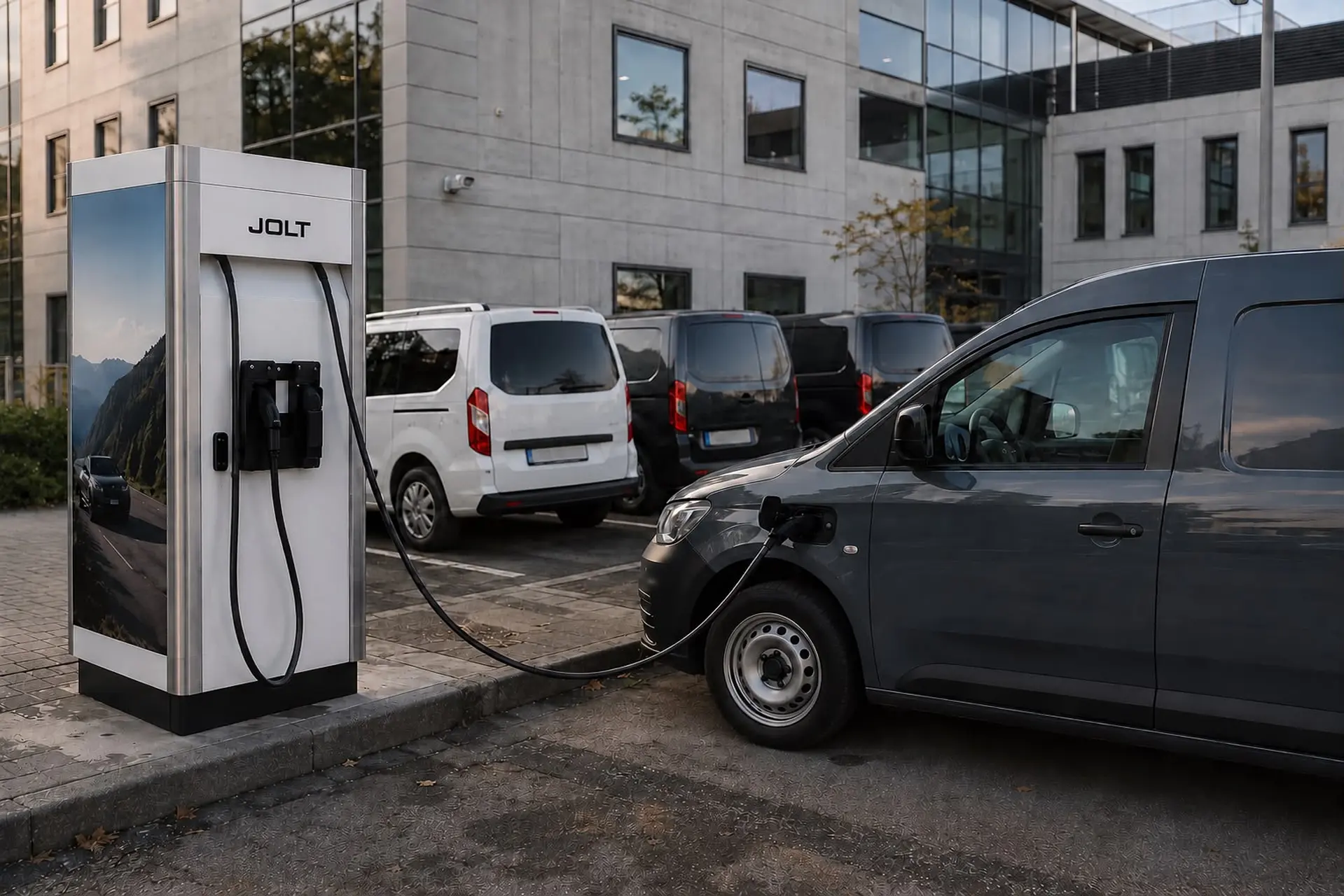
This is exactly where JOLT comes in. As a charge point operator (CPO), JOLT runs ultra-fast charging stations in the heart of the city, right where your vehicles are already on the move. With up to 320 kW charging power, you top up around 200 km of range in about ten minutes. That is often enough for half a working day in city traffic.
What makes this special: the charging stations have integrated battery storage. It enables ultra-fast charging on the standard low voltage grid, without any costly and time-consuming grid extension. For your company fleet, this means high availability around the clock, seven days a week. Public charging thus becomes the reliable third building block of your fleet electrification, complementing depot and home charging.
Fleet electrification increasingly pays off through total cost of ownership, not just the purchase price. More than 40% of operators expect lower total costs than a combustion vehicle over a replacement cycle of four to seven years. Electricity usually costs considerably less per kilometre than diesel, and electric vehicles need less maintenance.
Your company fleet also benefits in concrete ways:
Please note: tax and funding details depend on the individual case. For binding advice, consult a tax adviser.
A successful fleet electrification follows a clear roadmap:
With this approach, fleet electrification becomes predictable, cost-effective and future-proof.
With JOLT, your vehicles charge ultra-fast in the heart of the city, around the clock and without grid extension. Talk to our team and discover how commercial charging in the city drives your company fleet forward.
You are a journalist and want to reach our team? You want to sign up for press distribution list?
You need our press kit and brand assets? here is everything your might need.