
Interview: How to Find the Right Fast-Charging Station
Finding a fast-charging station: In this interview, JOLT CEO Jörg Lohr explains what to consider regarding location, power, and payment. ➤ Read now!
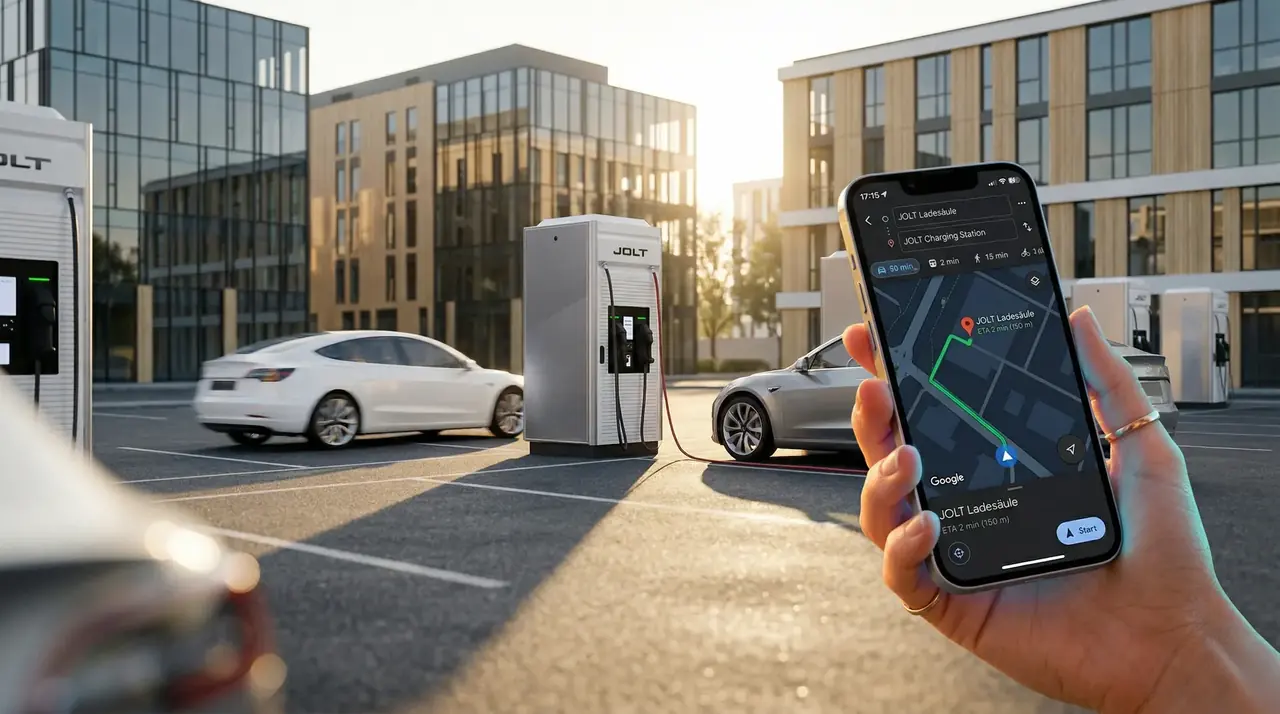
How to find the right fast charger: questions for JOLT CEO Jörg Lohr
The right fast charging station is one that suits your car, its battery level and your daily routine. In this interview, Jörg Lohr, Managing Director and CEO of JOLT Energy, explains how to identify a suitable fast charging station in a matter of minutes and why the highest kW figure is not automatically the best choice.
We've put together a short list of questions from our interview so you can quickly find what you're looking for.
The 60-second check on site
Before you plug in a cable, it is worth doing a quick reality check. This will help you find the right fast-charging station more quickly, even if you are in a hurry. We asked our expert the following questions:
Finding a location
Question: Would you say the location is important? Doesn't charging power matter most in the end?
Answer: Efficiency matters in everyday life, and the world is moving faster all the time. Even a suitable fast charger is of little use if you have to take a detour or its location is inconvenient. In the city, for instance, you can often get something else done while charging. And charging spaces usually don't incur parking fees. That's why I would always favour a charging station in the city.
Three tips for finding the best charging station
Question: Many chargers look alike. What are your three quickest checks to make sure everything works?
Answer: I think you should always ask yourself these questions:
- First, getting started: Is it immediately clear how to charge and pay?
- Second, the surroundings: Is it easy to reach, and does the location feel safe and suitable for a short break?
- Third, expectations: Does the charger fit the time you have available, meaning a short stop to reach 80 percent rather than a marathon to 100 percent?
If these three things are right, it is very likely the right fast-charging station.
When the charger is occupied
Question: Do you have a simple plan B if the location you had in mind is occupied?
Answer: Always plan for a second option nearby. Look for locations that provide clear information about availability, connector types and payment options. That reduces stress, especially at busy times.
Understanding charging power and charging curves
The technology seems complicated, but it is logical. What matters is how your car distributes power over the charging session: its charging curve. Jörg Löhr explains and dispels the myths:
The kW rating
Question: Many people focus only on 300 or 350 kW when looking at maximum power. Does that make sense?
Answer: Only to a degree. The vehicle does not draw maximum power continuously. We now know that charging power varies and is highly dependent on battery temperature. If the battery gets too cold or too hot, the battery management system reduces power. So the condition of the battery matters much more than the station's maximum output.
How much should you charge?
Question: Is charging to 80 percent really the standard?
Answer: For many people, yes, because charging often gets noticeably slower after that. The charging speed unfortunately drops at that point, leaving many wondering why it suddenly takes so long. So 80% is time-efficient and also lasts quite a while.
Charging power and saving time
Question: Is there a rule of thumb for an electric car's charging time?
Answer: I think in terms of time rather than maximum figures. If you want to charge for 10 to 20 minutes, very high power only helps if your battery is at the right charge level and the temperature is right. Otherwise, lower but steady power is often just as effective.
Temperature, winter and preconditioning
As we have already heard, whether a suitable fast charger actually charges quickly often depends on the battery temperature behind the scenes. You may notice this especially in winter.
Fast charging in winter
Question: Why does fast charging often feel sluggish in winter?
Answer: Because cold cells cannot take in as much power. If the battery is too cold or too hot, the battery management system reduces charging power. That protects the battery, but costs time. So it is better to charge after you have driven for a little while.
Fast charging in summer
Question: So charging can be throttled in summer too?
Answer: Yes. Charging is also regulated if the cells become too hot. This is normal and protects the battery. For you, it means that expecting peak charging speeds after driving in very hot conditions or during a heatwave is often unrealistic.
Preconditioning the battery: what does it actually achieve?
Question: Many people hear the advice to 'precondition'. What exactly does that mean?
Answer: If your car supports battery preconditioning, it can prepare the battery for maximum charging power at DC stations. The 'Prepare battery' function in the onboard computer is designed to keep charging sessions at DC stations as short as possible.
My tip for readers is to enter a suitable fast charger as the destination in your navigation system so preparation starts in good time, if your model supports it.
Payment, tariffs and common pitfalls
A fast charger is also a good choice when you can start without obstacles (and, above all, finish without them!). This is what separates good charging stations from bad ones.
Paying by credit card at charging stations
Question: Can I charge and pay without an app?
Answer: Of course. At JOLT, you can simply scan the QR code on the charging station, pay by credit card or mobile payment, and be ready to start in seconds.
App or charging card: which is more practical?
Question: What do you recommend for people who fast-charge regularly?
Answer: An app helps you find chargers, plan trips and pay. Our JOLT app, for example, is designed for exactly that, with a location finder and payment function.
Fluctuating prices
Question: Prices sometimes fluctuate. How do you assess that?
Answer: As with petrol or diesel, of course there are cheaper and more expensive times. Fortunately, with electric vehicles things are a little easier to understand. For example, we offer cheaper nighttime hours and fixed rates so everyone knows what costs to expect.
Why JOLT is the right fast charger for many drivers
If you regularly charge in the city, you are usually looking not for the largest charging park but for a suitable fast charger along your usual routes. But what does the market look like? We also asked Mr Lohr a few questions about JOLT:
JOLT's core approach
Question: What exactly should JOLT make easier for drivers?
Answer: Ultra-fast charging where it's needed: in the city. JOLT outlines its vision for an urban, battery-based charging network and describes fast chargers with integrated battery storage to reduce the need for extensive grid upgrades.
How can I quickly find the right fast charger at JOLT?
Question: What is your advice for charging with JOLT for the first time?
Answer: Use the location finder, check the connector type and tariff, and start charging whichever way suits you: via the app or with a credit card. You will soon see whether that fast charger fits your everyday needs.
Considering charging windows, temperature and payment together will help you find the right fast charger much faster. And if your daily life already takes place in the city, JOLT can be a very practical option without turning charging into a major undertaking.
Find a JOLT location now and plan your next charging stop with confidence!
Ultra-fast charging
Find a JOLT station near you
Up to 360 kW – in the middle of the city, around the clock.
Find a charging station