
How JOLT locations are selected
Interview with CEO Jörg Lohr: This is how JOLT selects locations for fast charging stations. ✓Criteria ✓Process ✓Partner Benefits ⇒ Read now!
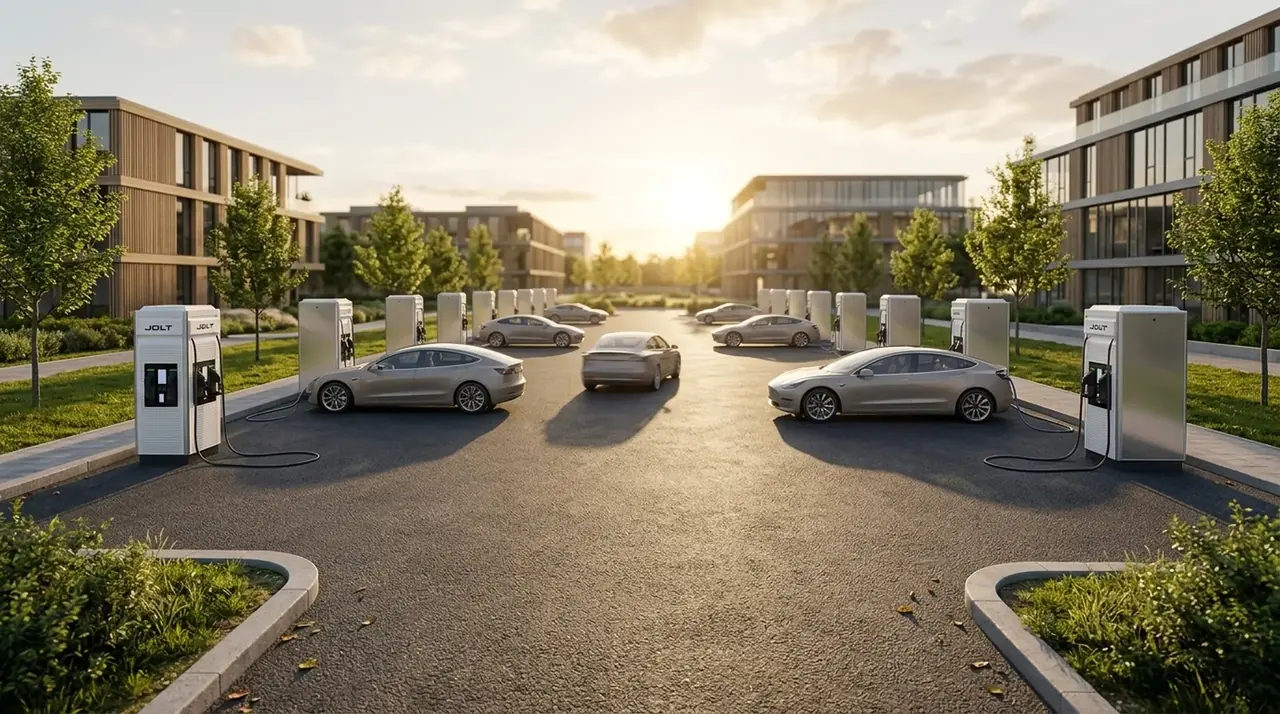
How are new JOLT sites developed? An interview with CEO Jörg Lohr
City centre, supermarket car park, petrol station, restaurant or busy transport hub: at first glance, a good charging location often seems to be ‘just there’. In practice, it is the result of a clear process involving data, technology and cooperation.
In this interview, Managing Director and CEO Jörg Lohr explains how JOLT charging station sites are selected, which criteria really matter and what it takes to bring ultra-fast charging into the city.
Why choosing the right location matters so much to JOLT
When you plan public charging infrastructure, the location is not just an address: it is the biggest factor affecting usage, utilisation and satisfaction.
Question: Mr Lohr, what is the key consideration when JOLT selects a location?
Jörg Lohr: Nobody wants to cross the whole city just to charge. So a charging station should always be built where people already spend time: shopping, eating, travelling to work or visiting busy neighbourhoods.
Question: Does that mean you plan according to user needs rather than 'available plots'?
Jörg Lohr: Exactly. A space is only interesting if it is convenient from drivers' point of view. Above all, we consistently think from the user's perspective: easy access, a clear approach and safe surroundings.
The most important criteria for selecting a site
Site selection is therefore not based on gut feeling but on a combination of criteria. It is always about balancing value for users, technical feasibility and the suitability of a site for partnership.
Question: How do you measure whether a site has enough demand?
Jörg Lohr: We examine various categories. These include traffic flows, how the surrounding area is used, dwell times and typical reasons for charging. A site can look central and still make little sense if people do not stay long enough or access is complicated.
Question: What role does ‘time’ play in this?
Jörg Lohr: A major role. Many people prefer to charge quickly for 10 to 15 minutes and carry on driving. That's primarily what we're optimising for.
Question: Are there any typical deal-breakers?
Jörg Lohr: Bottlenecks, confusing traffic layouts and spaces that are permanently blocked. Sites where operations constantly cause conflicts are difficult too. However, we often work with the responsible people on site to make everything run more smoothly.
Question: Are there any other important considerations? For example, regarding charging power?
Jörg Lohr: Depending on the system, we are talking about high-power charging of around 300 kW or more. What matters is that this power can be delivered reliably and that the site remains practical to operate and maintain.
How the process works: from idea to JOLT site
Many imagine site development as a linear process. In reality, it's a clearly defined process with repeated stages: assess, prioritise, coordinate, implement.
Question: How exactly does JOLT begin its site selection?
Jörg Lohr: Usually with a screening. We examine potential locations, evaluate them against our criteria and set priorities. The aim is to identify early on which locations have real potential and which would be too risky to develop.
Question: Which matters more here, speed or perfection?
Jörg Lohr: Both. We need to move quickly, but not hastily. A site that later falls through because of permitting issues costs everyone time. That's why we invest in a thorough assessment early on.
Question: You mentioned permits. How closely are municipalities involved?
Jörg Lohr: A very big one, especially in cities. We work in partnership because every city has its own requirements. Traffic flow, safety, design and regulatory conditions all have to fit.
Question: And what do outsiders often underestimate?
Jörg Lohr: How many details have to be sorted out before construction begins. From traffic routes and signage to how the site will work in everyday use. But experience shows that solutions can always be found.
What site partners should know about JOLT’s location selection
Many sites are developed because operators actively approach JOLT. For these partners, the important questions are: What is expected of them, and what does JOLT take care of? We also want to ask Mr Lohr these questions:
Question: What is the usual arrangement if someone wants to work with you?
Jörg Lohr: In short, you provide the space and we take care of planning, financing, implementation and operation. Our aim is to keep the work required of our partners to a minimum. After all, it should be worthwhile for everyone.
Question: What is the greatest advantage for partners?
Jörg Lohr: Many partners want charging infrastructure but not another construction site. To my mind, the biggest advantage is that our battery-buffered technology allows us to use a connection to the existing low-voltage grid at many urban sites. This makes it possible to develop locations where conventional high-power charging would otherwise require substantially more grid capacity and construction work.
We also bring the expertise, plan and finance the installation, and take care of operation and maintenance. You provide the space. For many partners this creates tangible added value, as extra customers visit the site and can stay there longer.
Question: Mr Lohr, finally: What would you like to tell businesses and site partners considering charging infrastructure?
Jörg Lohr: I would say: See charging infrastructure as a genuine opportunity. Anyone who wants to make a site future-proof today needs to consider mobility too. What matters is that the solution fits your customers' daily lives and operates reliably. That's exactly what we stand for at JOLT.
If you have a property that is easily accessible and already attracts footfall today, a conversation is almost always worthwhile. We quickly and transparently assess whether the site is suitable, then handle planning, implementation and operation.
In the end, it should be straightforward for you and noticeably better for drivers!
Ultra-fast charging
Find a JOLT station near you
Up to 360 kW – in the middle of the city, around the clock.
Find a charging station