
EV range in cold weather: how new cold-weather tests make winter range more realistic
Twenty-three degrees Celsius, no headwind, no heating: these are the laboratory conditions used to determine the range figure you see in a brochure. They bear little resemblance to a January morning on the motorway. Just how wide the gap can become was demonstrated by Norway’s El Prix test in January 2026. At temperatures as low as -31°C, not a single vehicle came close to its WLTP figure, with the average shortfall reaching almost 38% (heute.at, based on ÖAMTC data).
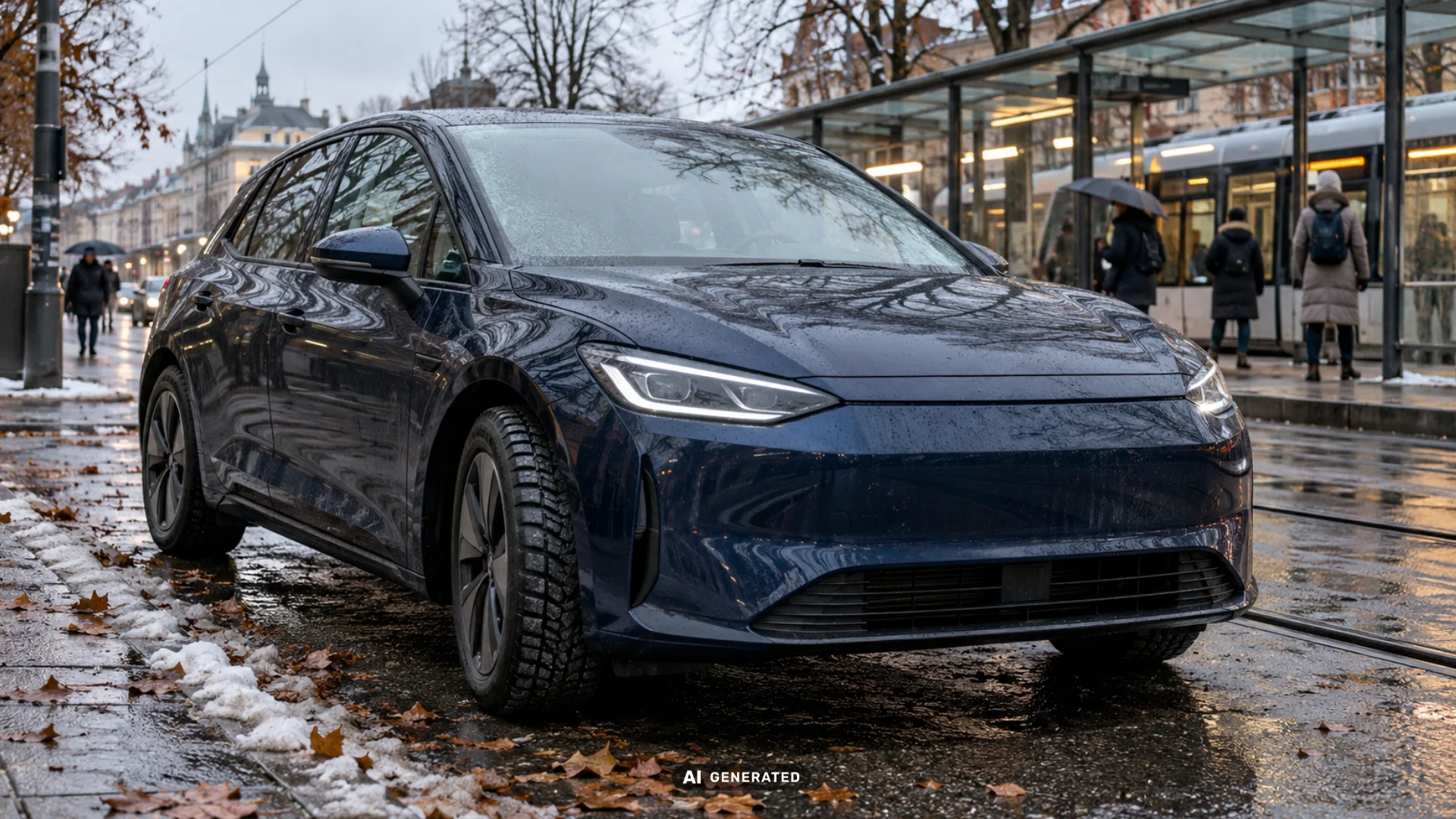
The EU is now addressing this issue. The Euro 7 emissions standard introduces an official cold-weather test at -7°C. In this article, you’ll learn why EV range in cold weather differs so much from laboratory figures, how the new test works and what it could mean for your everyday driving.
Why does WLTP tell you so little about winter range?
To understand why EV range suffers in cold weather, it helps to start with the testing procedure itself. WLTP is the European test procedure used to measure energy consumption and driving range. Laboratory testing takes place at an ambient temperature of 23°C – comfortable conditions for any EV battery. Auxiliary systems such as air conditioning are switched off, which the International Council on Clean Transportation (ICCT) says contributes to idealised results (electrive.com).
In winter, two effects occur at the same time. Low temperatures slow down the electrochemical processes inside the battery, while the cabin also needs to be heated electrically. A combustion-engine vehicle can use waste heat from its engine. An electric drivetrain, by contrast, is so efficient that very little excess heat is available.
The effect is particularly noticeable on short journeys. In an earlier ADAC measurement using the 30-minute WLTP cycle at -7°C, the energy consumption of some models, including the VW ID.5, doubled (auto motor und sport). There is another winter effect too: a cold battery accepts less power during fast charging because the vehicle protects the battery cells. You can find out more in our article on why your EV charges more slowly in winter.
Winter EV range tests: what ADAC and El Prix measured
There is currently no official winter range figure. So anyone looking for a winter EV range test today has to rely on independent motoring organisations. Two testing formats provide particularly useful insights.
ADAC: long-distance driving at 0°C
In January 2026, ADAC put 14 family-friendly EVs through a simulated journey from Munich to Berlin. Every model had to offer a WLTP range of at least 500 kilometres. In a climate chamber, the test bench recreated the real-world route along the A9 motorway: 582 kilometres, an average speed of 111 km/h, an outside temperature of 0°C and a deliberately cold start without a preheated battery.
The key findings:
- No vehicle completed the route without a charging stop, and most needed two 20-minute breaks.
- Test winner Audi A6 Avant e-tron covered 441 kilometres on a single charge and added enough energy for another 300 kilometres in 20 minutes.
- The Tesla Model Y was the most efficient at 22.2 kWh per 100 kilometres, while the BYD Sealion 7 consumed the most at 35.3 kWh.
On average, energy consumption was 57% higher than the WLTP figure (NWZ online, dpa).
El Prix: temperatures as low as -31°C
The Norwegian Automobile Federation NAF runs the El Prix twice a year together with the magazine Motor. In January 2026, 24 electric vehicles took part. At temperatures ranging from -8°C to -31°C, the cars achieved between 224 and 520 kilometres of range.
The Opel Grandland and Lucid Air recorded the largest deviations from their WLTP figures, at almost 46%. The MG S6 and Hyundai Inster came closest to their official figures, with losses of just under 30% (Konsument). There was also positive news when it came to charging: despite temperatures of around -10°C at the charging stations, the test vehicles performed well during charging.
Both tests provide valuable data, but they cannot be compared directly. Temperatures, routes and speeds differ significantly. A standardised testing procedure is intended to close precisely this gap.
EV cold-weather testing: what Euro 7 changes from late 2026
The Euro 7 Regulation entered into force on 29 May 2024. It applies to new passenger car types from 29 November 2026 and to all newly registered passenger cars from 29 November 2027 (TÜV NORD).
For the first time, an emissions standard also introduces requirements specifically affecting fully electric vehicles. These include limits for brake particle emissions and requirements for the durability of traction batteries. After five years or 100,000 kilometres, a battery must retain at least 80% of its original capacity. After eight years or 160,000 kilometres, the minimum is 72% (ADAC).
For EV range in cold weather, however, another element is particularly important. In addition to the standard WLTP measurement, a low-temperature test at -7°C is set to become mandatory. TÜV NORD expects the new procedure to give buyers greater transparency and encourage manufacturers to compete on winter range.
How the -7°C cold-weather test works
The methodology comes from the United Nations Economic Commission for Europe (UNECE) and extends the global WLTP regulation GTR 15 with a low-temperature test. Instead of running at 23°C, the vehicle is tested at -7°C, while the climate control is set to 22°C. In other words, the car has to heat the cabin – just as it would on a real winter day. Factors used to define so-called test families include the battery management system and battery preheating technology.
In March 2026, the UN World Forum WP.29 adopted the corresponding revision of UN Regulation No. 154. On 27 May 2026, the European Commission then published a draft implementing regulation for consultation. It adds a dedicated annex on electric driving range at low temperatures to the existing Commission Implementing Regulation (EU) 2025/1706. According to the draft, testing would take place not only during type approval but also on vehicles already in service (InterRegs).
What remains unclear
As of October 2026, the EU implementing act was still available in draft form. The details of the final version therefore remain to be seen.
It is also not yet clear where drivers will eventually find the cold-weather range figure. The new digital Environmental Vehicle Passport is expected to include information such as electric driving range. However, the available sources do not confirm whether a separate winter range figure will also be displayed. Back in 2022, the ICCT recommended showing cold-weather range and energy consumption separately in sales materials and on efficiency labels (heise online).
And one more point: -7°C represents typical winter conditions, not extreme Arctic cold. For exceptionally low temperatures, tests such as El Prix will therefore remain a valuable additional source of information.
What do the new cold-weather tests mean for you?
When buying an EV, you will eventually gain a second, more realistic benchmark. Once the new EV cold-weather test delivers comparable winter figures across different models, you will be able to look at the WLTP figure and the cold-weather result together to understand the range between ideal conditions and a winter day.
Until official cold-weather figures become available, independent tests remain useful. Two equipment features are already worth looking at more closely:
- Heat pump: Every competitive model in the ADAC winter test was equipped with a heat pump.
- Efficiency: According to ADAC, electricity costs for covering the same distance were 60% higher in the BYD than in the more efficient Tesla.
A few simple habits can also help you get noticeably more from every battery charge in everyday winter driving:
- Preheat while connected to the grid: Use EV preconditioning to bring the battery into its ideal temperature range before charging or setting off.
- Charge with a warm battery: Ideally, charge after you have already been driving for a while rather than immediately after starting your journey.
- Allow a buffer: Remaining range can drop faster than expected in cold weather. Our guide to emergency charging when your EV battery is empty explains what to do if your remaining range becomes critically low.
Winter charging in the city: how JOLT supports you
In winter, every minute at the charging station matters. JOLT brings ultra-fast charging directly into city centres, with up to 320 kW of charging power, around 200 kilometres of range in approximately ten minutes and 24/7 availability. Integrated battery storage makes this possible without costly grid extensions.
Important during the colder months: our ultra-fast chargers provide the stated charging power, but your vehicle determines how much of that power it can actually accept. If you arrive with a warm battery—for example, after a longer drive or with preconditioning activated—you can make the most of the speed available at our stations.
Sources
- ADAC: Winter stress test: how suitable are EVs for family journeys? (22 January 2026). https://www.adac.de/rund-ums-fahrzeug/elektromobilitaet/elektroauto/elektroauto-reichweite-im-winter-adac-test-2026/
- ADAC: Euro 7 emissions standard: when it arrives and what changes (23 September 2026). https://www.adac.de/rund-ums-fahrzeug/autokatalog/abgasnormen/euro-7/
- TÜV NORD: New standard, new rules: what changes with Euro 7? (11 July 2024). https://www.tuev-nord.de/de/wissen/explore/neue-norm-neue-regeln/
- InterRegs: Additional Draft Euro 7 Emissions Implementing Regulations Published (June 2026). https://www.interregs.com/articles/spotlight/329/additional-draft-euro-7-emissions-implementing-regulations-published
- EUR-Lex: Commission Implementing Regulation (EU) 2025/1706 of 25 July 2025. https://eur-lex.europa.eu/eli/reg_impl/2025/1706/oj
- UNECE, GRPE-92-08: Euro 7, UN transposition plan (March 2025). https://unece.org/sites/default/files/2025-03/GRPE-92-08r1e.pdf
- heise online: Electric cars: the WLTP cycle lacks a cold-weather consumption figure (2022). https://www.heise.de/hintergrund/Elektroautos-Dem-Zyklus-WLTP-fehlt-ein-Frost-Wert-fuer-den-Verbrauch-7249719.html
- electrive.net: How the WLTP range of electric vehicles is determined (2022). https://www.electrive.net/2022/04/02/wie-die-wltp-reichweite-von-elektroautos-ermittelt-wird/
- electrive.com: How WLTP range is really calculated (2022). https://www.electrive.com/2022/05/23/how-wltp-range-is-really-calculated/
- heute.at: Revealed: the real-world range of electric cars (February 2026, ÖAMTC data). https://www.heute.at/s/enthuellt-das-ist-die-echte-reichweite-der-e-autos-120163315
- Konsument (VKI): Electric cars in real-world testing: extreme cold, acceptable range (2026). https://konsument.at/e-autos-im-praxistest-reichweite-bei-kaelte
- t-online: Electric cars in cold weather: which EVs go the furthest? (2026). https://www.t-online.de/mobilitaet/aktuelles/id_101106828/e-autos-reichweite-bei-kaelte-diese-stromer-kommen-am-weitesten.html
- Electric Fleet: WLTP vs CLTC: What You Need to Know About EV Range Standards (August 2026). https://electricfleet.online/wltp-vs-cltc-ev-range-standards-explained/
- NWZ online (dpa): Test: how far family-friendly EVs travel in winter (January 2026). https://www.nwzonline.de/motor-meldungen/14-modelle-im-adac-testlabor-test-so-weit-kommen-familienfreundliche-e-autos-im-winter_a_4,2,3572367958.html
- auto motor und sport: EVs in winter, ADAC measurement at -7°C (2024). https://auto-motor-und-sport.de/tech-zukunft/alternative-antriebe/elektroauto-reichweite-bei-kaelte-test/amp
Ultra-fast charging
Find a JOLT station near you
Up to 360 kW – in the middle of the city, around the clock.
Find a charging station