
EV plug types: CCS, Type 2 and more explained
Do you know all the EV plug types? Whether it's the CCS plug, Type 2 plug or CHAdeMO: We explain all charging station connectors. => Find out more now!
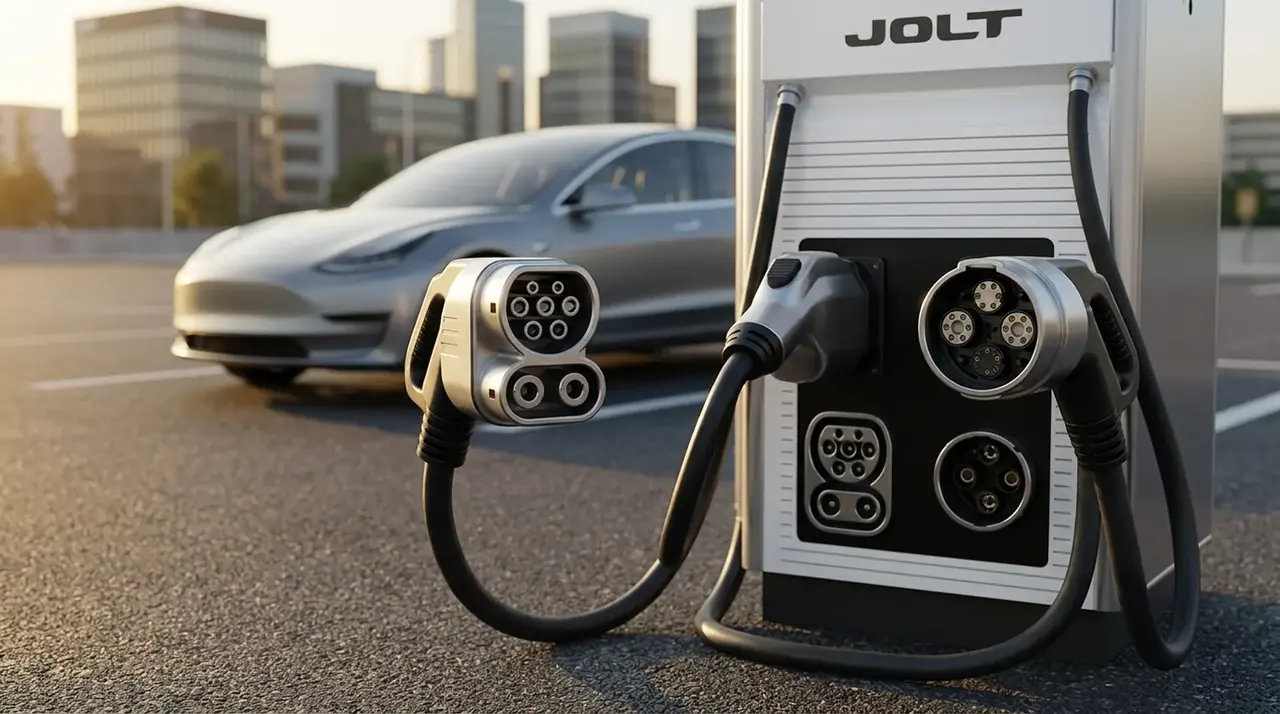
Every EV plug type explained: your guide through the charging maze
Switching to electric mobility is an exciting step towards a greener future. But newcomers in particular often face a small technical hurdle. When you park at a public station for the first time, you might wonder: what types of EV charging plugs are there, and which one fits my car? Do not worry: the variety of cables and sockets initially looks much more complicated than it really is in practice.
In this comprehensive guide, we clear up the confusion. We explain why the CCS connector is indispensable for fast-paced road trips, what you need a Type 2 connector for in everyday city driving, and where the less common CHAdeMO fits in. That way, you can immediately find the right charging connection every time, without the stress.
The essentials: alternating current (AC) versus direct current (DC)
To really understand the different EV connector types, it helps to take a quick look at the basics of charging technology. Electricity from the public power grid always arrives as alternating current (AC). However, your vehicle's powerful battery can only store energy as direct current (DC). So the electricity has to be converted.
With leisurely AC charging, an inverter built into the vehicle handles this task. This is gentler on the battery but takes a lot of time. With rapid DC charging, also known as fast charging, this complex conversion already takes place inside the substantial charging station itself. Electricity flows directly into your battery at enormous power. There are perfectly adapted EV connector types for each of these very different power classes.
Europe’s everyday standard: the Type 2 connector
The undisputed standard for AC charging in Europe is the Type 2 connector. It is also often called the Mennekes connector after the company that originally developed it. If you plug your vehicle into a wallbox in your garage after work or charge during the working day, you will generally use exactly this Type 2 connector.
- Availability: It comes as standard on virtually every modern electric vehicle built for the European market.
- Power: Standard charging power here is usually between 11 kW and 22 kW.
- Safety: A clever mechanism locks the Type 2 connector securely into the car and the station during charging, so it cannot be removed without authorization.
This technology is ideal for convenient charging while you do something else. But if you are on the move in a busy city and quickly need extra range for your next appointments, its charging time becomes a significant limitation.
The powerhouse for ultra-fast charging: the CCS connector
This is where forward-looking High Power Charging (HPC) comes in. If you are an EV driver who does not want to waste valuable time, the CCS connector (Combined Charging System) is your most important companion. This standard has established itself as the clear industry leader for ultra-fast charging in Europe and North America.
The clever thing about the CCS connector is that it builds directly on the proven Type 2 design, simply adding two large, powerful DC contacts underneath. When you open the charging flap on a modern electric car, you will usually see a combined socket that can easily accommodate both EV connector types.
The CCS connector enables breathtaking charging speeds. Our modern JOLT fast-charging stations use this advanced technology to supply electric vehicles with up to 360 kW of power. In practical terms, this means for you:
- In just 10 minutes, you can add enough electricity for up to 200 kilometres of range.
- Long waits and even range anxiety are finally a thing of the past.
- Plug in the CCS connector, enjoy a quick coffee and carry on with your day seamlessly and without stress.
The Asian pioneer: CHAdeMO
Alongside the dominant European standards, there is another standard you may occasionally encounter: CHAdeMO. This DC connector was originally developed in Japan and was very popular on the earliest generations of Asian electric cars.
Although CHAdeMO connectors are still fairly common worldwide, they are rapidly losing significance in the European market. Most global car manufacturers now consistently equip new models sold in Europe with the more powerful CCS standard. Nevertheless, many older public fast-charging stations still offer the relevant connector so that existing vehicles can continue to charge reliably.
Practical tips: using the right connectors at charging stations
Fortunately, using a public charging station in everyday life is remarkably intuitive and simple. At ultra-fast DC chargers, the heavy cables are permanently attached to the station. That is because the extremely high currents require particularly thick cables, some of which are even liquid-cooled. So you do not need to haul your own heavy cable out of the boot.
Park your car, choose the right connector at the charging station (in most cases, the CCS plug), connect it to your vehicle and conveniently start charging via an app, charging card or credit card. For slower AC charging at smaller urban stations, however, you will usually need to bring your own lightweight Type 2 cable.
JOLT Energy: your fast charging solution in the city
At JOLT Energy, we know that a carefree everyday experience with an electric car depends on reliable, widespread and, above all, ultra-fast infrastructure. That is why we bring fast charging right to you in city centers. Our innovative stations blend seamlessly into the urban environment and give drivers access to state-of-the-art charging technology at any time. Soon, charging your vehicle will be as routine and straightforward as parking it.
A brief note for site owners: Do you own a supermarket, petrol station or restaurant in an urban location? You too can benefit from the rapid growth of electric mobility! As an experienced charge point operator (CPO), JOLT plans, finances and operates premium fast chargers on your premises. Without investing any of your own money, you can enhance your location, attract EV drivers with spending power and generate additional revenue along the way. Contact us and actively help shape tomorrow's mobility!
Ultra-fast charging
Find a JOLT station near you
Up to 360 kW – in the middle of the city, around the clock.
Find a charging station