
Public and Private EV Charging Infrastructure: Why Cities Need Both
As the number of electric vehicles grows, so does the question of where they can be charged reliably. Conditions vary considerably, particularly in densely populated areas: while some people can charge their EV on a private parking space, others depend on charging options while out and about. Future-proof EV charging infrastructure in cities must therefore reflect different everyday needs and bring together a range of charging solutions in a practical way.
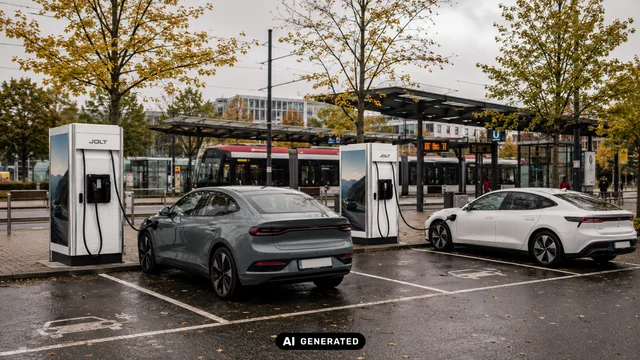
Private charging infrastructure covers an important part of everyday charging needs
People with access to a garage or private parking space can often charge their EV where it is parked for several hours anyway. Private charging infrastructure at home, for example, makes it possible to recharge a vehicle overnight. Charging points in company car parks can also meet part of the daily demand for EV charging.
However, this option is far from available to everyone. Particularly in densely built-up neighbourhoods with apartment buildings, on-street parking and limited private space, installing a dedicated charging point is not always possible. Private charging points are therefore an important part of e-mobility, but they cannot meet the charging needs of an entire city on their own.
Public charging infrastructure gives more people access to EV charging
This is where public charging infrastructure comes in. Charging stations in public or publicly accessible spaces allow drivers to charge even when no suitable connection is available at home or at work. Public charging points therefore complement private charging options and provide greater flexibility in everyday life.
There is also the need to charge while on the move. Drivers who need additional range between appointments, while shopping or during a longer journey rely on charging options that are easy to reach. Public charging infrastructure should therefore provide not only a sufficient number of charging points but also the right locations and charging speeds. For municipalities, site selection, space availability and existing infrastructure are therefore important considerations when planning new charging facilities.
EV charging infrastructure in cities must meet different needs
Effective urban charging infrastructure cannot rely on a single charging solution. What matters is how different options work together. Slower charging can make sense in places where vehicles remain parked for several hours, while fast charging points are particularly useful when drivers need to add range within a short period of time.
For EV charging infrastructure in municipalities, this means that the number of charging points is not the only factor that matters. It is equally important to understand which charging solutions are actually needed at each location. Data on existing infrastructure and future demand can help municipalities plan expansion more strategically.
Urban charging infrastructure needs the right locations
Space is particularly limited in cities. New charging facilities compete with parking spaces, green areas, cycle lanes and other uses of public space. Urban charging infrastructure should therefore make the most efficient use of the space available. The selection of suitable charging locations plays an important role, with decisions ideally based on actual charging demand and local conditions.
Fast charging can be a valuable addition in this context. Shorter charging sessions allow a charging point to serve more vehicles throughout the day. At JOLT, we therefore focus on high-performance, space-efficient charging infrastructure for urban locations. Our battery-buffered solutions can be connected to existing low-voltage grids, helping to support the deployment of charging infrastructure at locations with limited grid capacity.
Municipalities can drive charging infrastructure expansion strategically
For cities, the key is to avoid looking at private and public charging options in isolation. In neighbourhoods with a high number of private charging points, demand for public charging stations may be lower than in areas where many people do not have their own parking space and rely on on-street parking. Forward-looking planning therefore takes residential structures, traffic flows, suitable locations and different charging needs into account.
This approach can create EV charging infrastructure in cities that makes e-mobility practical and accessible for as many people as possible. At JOLT, we support the public sector with high-performance charging solutions for urban environments.
Ultra-fast charging
Find a JOLT station near you
Up to 360 kW – in the middle of the city, around the clock.
Find a charging station