
EV charging curve: Why charging speed fluctuates
Understand your EV charging curve and optimise charging times. Discover how ultra-fast charging with JOLT accelerates your day and your business. => Check our Tipps tips now!
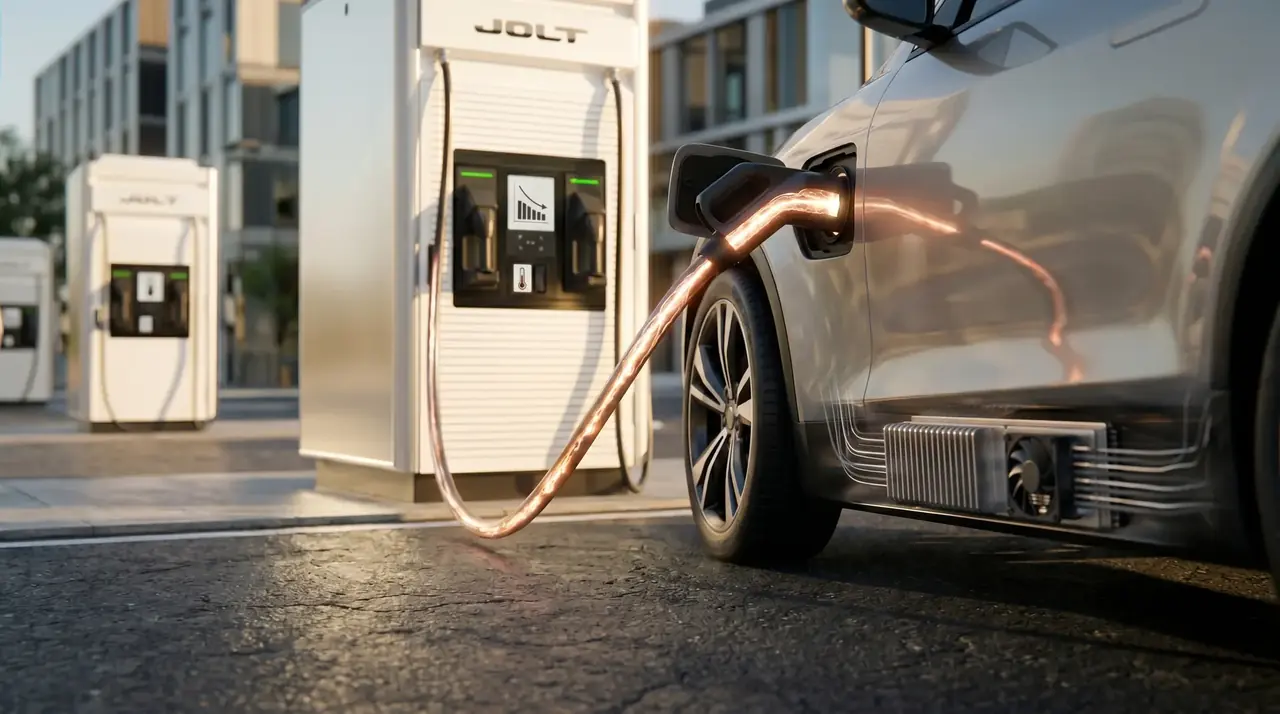
EV charging curves: Why charging speed does not stay constant
When you connect your electric vehicle (EV) to a fast charger, you expect maximum power. In practice, however, you will often find that charging speed drops after a certain point. Experts describe this phenomenon using what is known as the EV charging curve.
As a forward-looking charge point operator (CPO) for premium charging infrastructure, we know the tricks and explain why charging power varies for physical reasons and how you can minimise the time you spend at a charger.
What exactly is an EV charging curve?
The charging curve shows the relationship between the battery's current state of charge (SoC) and the charging power achieved at that point (in kilowatts, kW). A battery cannot take in electricity at the same maximum rate throughout the entire charging cycle. The rate therefore gradually tails off.
Why charging power drops: Your battery’s protection mechanism
Many EV drivers see the phenomenon live on the charging station's display: after a rapid initial phase, they suddenly notice the charging power drop. However, this moment is no cause for concern; it marks an important and entirely normal transition in your electric car's charging cycle.
Up to a state of charge of around 80%, the vehicle charges in what is known as constant-current mode. During this phase, the maximum amount of energy flows quickly and freely into the battery cells. Once the cells reach a certain voltage and charge level, however, the system switches to constant-voltage mode. From that point onwards, charging power must decrease for physical reasons.
The battery management system (BMS) now actively reduces the current flow. The reason is simple: to protect the sensitive lithium-ion cells from overheating, overcharging and premature wear. Even though charging power inevitably drops towards the end of the charging cycle, ultra-fast charging technologies make sure you can make the most of the initial phase of maximum power intake.
Key factors affecting charging speed
Besides the current state of charge, other variables determine how quickly electricity actually flows into your vehicle:
- Battery temperature: The optimum operating temperature for lithium-ion batteries is between 20 and 40 degrees Celsius. If the battery is too cold in winter or too hot after a long motorway drive, the BMS automatically reduces charging power to protect the cells.
- Vehicle hardware: every EV model has a specific maximum charging power and a charging curve individually programmed by its manufacturer.
- Charging station power: Your EV can only charge as fast as the connected station can supply energy. High-power solutions are needed here.
Ultra-fast charging with JOLT: Leading technology
To make full use of your EV's charging curve, you need infrastructure that reliably delivers sustained high power. That's where JOLT Energy comes in. Our goal is to revolutionise urban mobility through ultra-fast charging.
We offer cutting-edge HPC (High Power Charging) solutions such as the MerlinOne, delivering an impressive 300 kW (2 × 150 kW). We also use the compact ChargeBox, which can even provide up to 320 kW of charging power. Our infrastructure is designed to supply vehicles with enough electricity for up to 200 km of range in just 10 minutes.
A revolutionary advantage: our charging stations have integrated battery storage. This allows us to connect them seamlessly to the standard low-voltage grid without time-consuming and expensive grid upgrades. The system acts as an intelligent energy store, balancing the supply of electricity from renewable sources in real time and thereby stabilising the local power grid.
Tips to optimise your charging session
Using your EV's charging curve strategically saves valuable time in everyday life:
- Charge in the optimal window: End your ultra-fast charging session at around 80% SoC. Charging the remaining 20% takes a disproportionately long time because the curve flattens.
- Use preconditioning: Many modern electric cars can automatically bring their battery to the ideal temperature via the navigation system on the way to the charging station.
- Choose premium networks: Use stations run by a reliable Charge Point Operator (CPO) to access the highest possible charging power.
Attractive charging solutions for businesses and site partners
Installing ultra-fast charging infrastructure offers significant commercial opportunities for decision-makers in retail, at filling stations and in commercial real estate. By partnering with JOLT as a site host, you enhance the value of your property and attract customers with strong purchasing power who use your services while their vehicles charge.
We handle the planning, financing and operation of premium charging stations at your site. Because our systems, such as the ChargeBox, make highly efficient use of space and do not require grid expansion, you do not need to invest your own money. You provide the space and benefit from additional revenue while focusing entirely on your core business.
Conclusion: Make smart use of the charging curve
The flattening charging curve of an electric car is not a technical fault but an essential, highly intelligent protection mechanism for your battery. With the right charging strategy and access to JOLT's first-class ultra-fast charging solutions, you can fit charging seamlessly into your journeys. We make charging in urban areas easy. For a fully electric future.
Ultra-fast charging
Find a JOLT station near you
Up to 360 kW – in the middle of the city, around the clock.
Find a charging station