
Section 14a EnWG and Grid-friendly Charging: What You Need to Know
As the number of electric vehicles grows, so does the number of high-powered home EV chargers. At the same time, electricity grids need to manage periods of high demand reliably. This is where Section 14a of the German Energy Industry Act (EnWG) comes in. The regulation provides a framework for flexibly controlling certain electrical devices while still enabling new grid connections. Below, we explain what this means for your home charger and your everyday charging routine.
What Does Section 14a EnWG Regulate for Home EV Chargers?
Section 14a EnWG applies to so-called controllable consumption devices connected to the low-voltage grid. These include private EV charging devices with a grid connection capacity of more than 4.2 kW if they were commissioned on or after 1 January 2024. Transitional arrangements apply to older installations.
The basic principle is straightforward: in certain grid congestion situations, the distribution system operator may temporarily limit the power available to a controllable EV charger. In return, operators benefit from reduced network charges. A connection should also not be delayed or refused solely because the local grid may experience temporary capacity constraints.
How Do Grid-oriented and Controlled Charging Work?
In everyday language, terms such as grid-friendly charging or controlled charging are often used. For the rules under Section 14a EnWG, the German Federal Network Agency primarily refers to grid-oriented control. Charging power is not reduced arbitrarily, but only when there is a specific risk of the relevant section of the grid becoming overloaded.
For an individual controllable consumption device such as an EV charger, a minimum power of 4.2 kW must generally remain available. This means the electric vehicle can continue charging. Normal household electricity consumption is not affected by the control mechanism. Charging your vehicle in a grid-friendly way therefore does not automatically mean that the charging process will be interrupted.
What Technology Does a Controllable EV Charger Require?
For EV charger control to work, the charging device must be technically capable of receiving and responding to control signals. A charger that complies with Section 14a EnWG should therefore be integrated in a way that allows these signals to be implemented reliably. In principle, technical communication is based on a smart metering system combined with a connected control device.
This type of control unit can transmit signals to the EV charger or to an energy management system. The exact technical setup depends, among other things, on the metering point operator and the existing installation. Anyone planning a new home charger should therefore clarify the required components with their electrical contractor, distribution system operator and metering point operator at an early stage.
What Are the Benefits of Grid-friendly Charging?
Grid-friendly charging is designed to integrate additional electrical loads more effectively into existing distribution networks. By selectively reducing peak loads, the local electricity grid can respond more flexibly when many consumers require large amounts of power at the same time. Households can also benefit financially from reduced network charges.
In the long term, controlled charging is therefore becoming an important part of the electrification of both mobility and heating. It is particularly useful when combined with intelligent load management. If a building has several high-powered electrical devices, an energy management system can coordinate their power consumption and distribute the available energy efficiently.
What Does Section 14a EnWG Mean for Public Charging Stations and JOLT?
The rules for controllable consumption devices apply to private home EV chargers, but not to publicly accessible charging points as defined by Germany's Charging Station Ordinance. Public fast-charging infrastructure is therefore subject to different regulatory requirements.
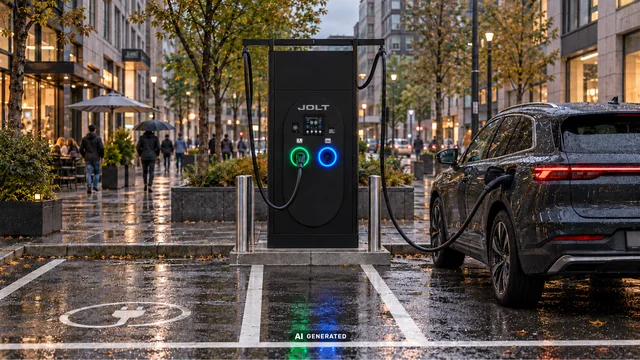
Efficient use of grid capacity remains important in this area, too. At its urban fast-charging stations, JOLT uses integrated battery storage. The batteries store energy and enable high charging speeds while requiring comparatively moderate connection capacity from the low-voltage grid. This demonstrates that, even beyond Section 14a EnWG, intelligent control, battery storage and flexible charging infrastructure can help integrate e-mobility efficiently into existing electricity networks.
Ultra-fast charging
Find a JOLT station near you
Up to 360 kW – in the middle of the city, around the clock.
Find a charging station