
Peak Shaving & Load Management: Smoothing out power peaks
Reduce costs through peak shaving & load management at charging stations. ✓Grid stability ✓HPC ✓Battery storage ➔ Optimise your charging infrastructure efficiently with JOLT!
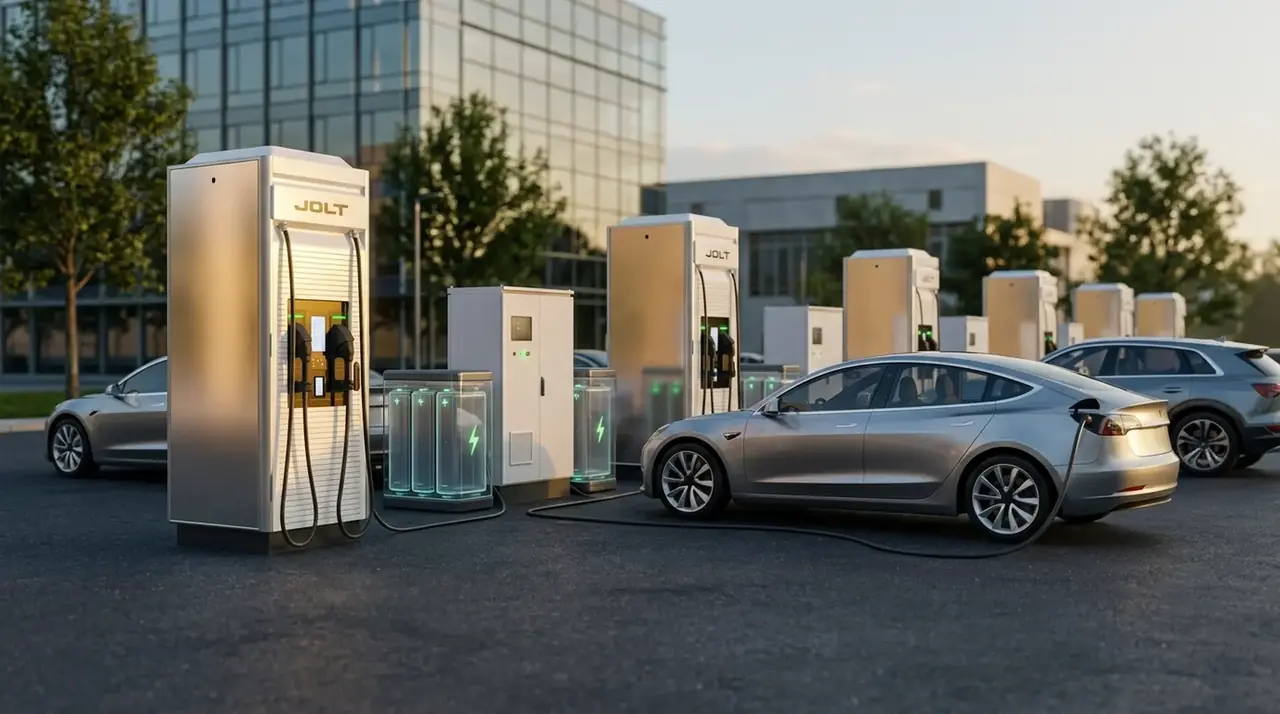
Peak shaving and load management: how smart chargers smooth out demand peaks
Electric mobility is a driving force behind the modern transport transition, but presents companies and grid operators with a Herculean logistical challenge. When several vehicles charge at high power simultaneously, the building's grid connection comes under enormous strain. Without intelligent control, the result can be expensive grid charges or even local power outages.
Two concepts are coming to the fore to solve this problem: load management for charging stations and peak shaving. Users often do not notice these processes when visiting the relevant locations; they simply benefit from a reliable electricity supply.
What is load management at charging stations?
Modern load management acts as the brain of the charging infrastructure. It ensures that the total electrical power available is distributed optimally among all active charging points. Rather than assigning the maximum power to each vehicle indiscriminately, the system controls the flow according to demand. The aim is to manage charging power so that the building's grid connection is never overloaded while vehicles still charge as quickly as possible.
While a static system merely divides up a fixed maximum, dynamic load management takes a crucial step further. It communicates in real time with the building's energy management system. For example, if a production plant or office air conditioning uses a lot of electricity, smart charging stations automatically reduce their power. Once internal consumption falls again, more power is immediately available to the vehicles.
Peak shaving: avoiding costly demand spikes
So-called peak shaving at charging stations (cutting peak loads) is the gold standard of energy optimisation. It involves smoothing out short periods of extremely high electricity demand, known as peak loads. This is particularly relevant for businesses because grid charges are often calculated on the basis of the highest measured peak. Smoothing these peaks drastically reduces fleet operating costs.
The benefits of grid-friendly charging infrastructure
In this section, we look at why investing in smart technology makes sense not only environmentally, but above all financially:
- Avoid expensive grid upgrades: You can operate more charging points without paying to expand the physical grid connection.
- Lower capacity charges: By smoothing demand peaks, you noticeably reduce your monthly electricity costs.
- Maximizing the use of PV systems: Intelligent load management prioritizes charging with your own solar power.
- Greater grid stability: you operate grid-friendly charging infrastructure that eases the burden on the public grid instead of straining it.
- Scalability: Your HPC charging infrastructure grows with your fleet, because new charging points can easily be integrated through software.
Battery-buffered solutions for high-power charging
Battery-buffered charging infrastructure is a particularly innovative solution for locations with weak grid connections. Here, batteries act as an intermediate buffer for charging stations. The storage unit charges slowly from the grid when demand is low and releases its energy in bursts during high-power charging (HPC).
This principle enables ultra-fast charging without pushing the local transformer to its limit. Battery-buffered charging stations like these are ideal for public fast-charging infrastructure: they can make a site ready for charging in a very short time without years of waiting for a stronger grid connection.
Smart charging as the standard
To make the transition to electric mobility financially viable, peak shaving is now indispensable. Those who can smooth peaks in demand and rely on smart charging stations protect the grid while saving real money. With easy operation via the app, fair tariffs and a growing number of upgraded locations, charging infrastructure becomes a success for operators and drivers alike.
Ultra-fast charging
Find a JOLT station near you
Up to 360 kW – in the middle of the city, around the clock.
Find a charging station