
“Being present where commuters are” – Jolt CEO Jörg Lohr in an interview
There are already many fast chargers along highways, and now numerous providers are increasingly turning their attention to commuter traffic. From the very beginning, Jolt Energy has specialized in fast chargers in urban areas. Since September, Jörg Lohr has been the new CEO and now explains his strategy for the company in an in-depth interview […]
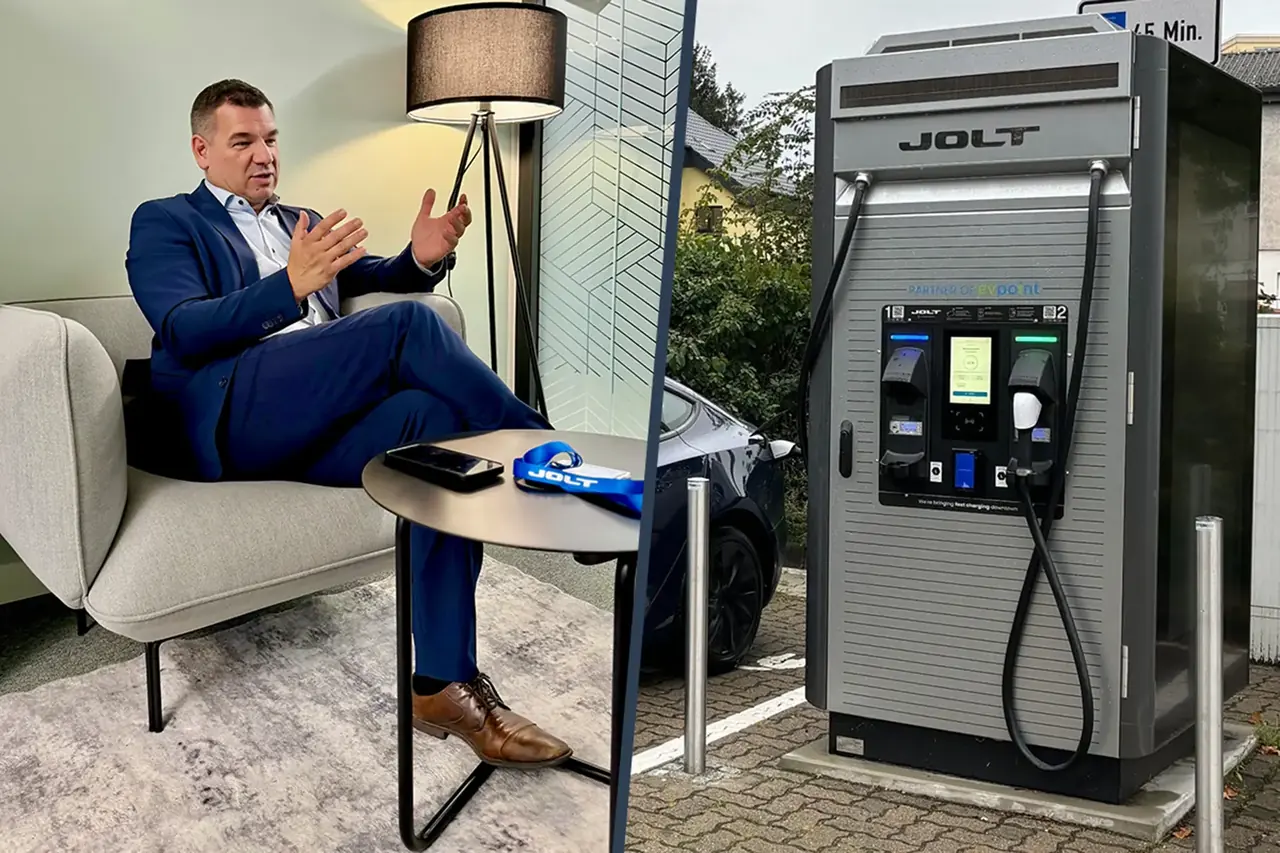
December was a busy month for Jörg Lohr. Since taking over as CEO of Jolt Energy GmbH in September 2025, he has had to get to know the team and the company in depth while also making important, fundamental decisions at speed. A strategy review with the investor was on the agenda: nothing less than the question of where the new CEO wants to take the company. Would there be a complete break with the existing strategy, a fresh start? Or a cautious but important adjustment to its previous direction?
Lohr had already given a clue about the future strategy before his major interview with electrive: in December, Jolt commissioned a new charging station in Lohr's presence. It is at Leipziger Platz, right outside the Spy Museum. What makes it special is not only its integrated battery storage but also that it was installed on public land belonging to the city of Berlin. Jolt Energy is thus staying true to its focus: fast charging in the city, generally paired with a buffer battery because of grid connection constraints.
Nevertheless, there is plenty to discuss: Which cities does JOLT want to operate in? And which locations within those cities? What will the future pricing model look like, and who will supply the hardware? And what does the new CEO of a charge point operator (CPO) want from policymakers?
Mr Lohr, you have been the CEO of Jolt Energy since 2025 and have got to know the company since then. What did you find when you took stock? Where does Jolt stand today?
"The assessment was very revealing because it also reflected the situation in the industry when I joined the company. As with many market participants, Jolt's business model was fundamentally very well thought out. High-power charging in urban areas has attracted significantly more public attention over the past six months or so. And Jolt adopted this approach very, very early on.
The challenge, however, as so often, lies in consistently implementing a fundamentally sound strategy and translating it into clear strategic actions. It starts with selecting suitable chargers, continues with the quality of sites and also affects the company's focus. Looking back, we have to admit that customer satisfaction did not always receive the priority it should have. But I am convinced that lasting commercial success comes not from investor capital but from satisfied customers. Customers must therefore be our focus. In this respect there are, and have been, specific challenges, particularly regarding charger uptime, reliability and availability. These metrics were not at the level we set for ourselves. That is precisely where we are taking action now.
In my view, a major advantage for Jolt is the strong backing of an investor who not only firmly believes in electric mobility but also provides enough funding to enable the next stage of the company's growth. In a market environment that remains highly volatile, that is anything but a given and provides an important foundation for the company's further development."
You have already given us plenty of talking points for the rest of our conversation. Let's start with your expansion targets, because new charging stations are the most visible sign of growth for customers. There are still major gaps in Germany, while charging points already exist in the Netherlands and Scandinavia. Where does JOLT want to have its fast chargers, and where not?
“JOLT's infrastructure is already where many other CPOs are only now trying to go: in inner-city areas. What we've lacked so far is a clear focus. We now have that with our strategic plan: we will serve Germany's largest cities and their surrounding regions, treating the Ruhr area as one continuous metropolitan region rather than as individual cities. We have learned in metropolitan areas that it makes more sense to operate, for example, 30 chargers in one city than one charger in each of 30 cities.
Take Munich as an example. In the metropolitan region, we want to be where the commuters are. Around half a million people commute into Munich every morning and back out in the evening, as far as Ingolstadt, Augsburg, Landsberg am Lech or 30 to 40 kilometres to the east. Alongside further expansion in the city centre, it is therefore important to have a presence along commuter corridors. The aim is for users on their way home, particularly those without a way to charge at home, to be able to use a continuous network from a single provider.
We are looking at this approach not only in Germany; there are also major cities in other European countries where this model is of interest. Sweden and the Netherlands are long-established markets, as they were among the company's original markets. But we are examining other markets too, to see whether entering them makes sense and, if so, in what form. That strategic review is still ongoing.
But the investor and I agreed very quickly on one thing: we do not want to compete with providers such as Ionity or Fastned. Motorway locations are not a focus for Jolt. There is already enough competition there."
What does an ideal site for Jolt Energy look like? Until now, the best-known sites have been at Esso petrol stations, where there are usually only two charging points. Will you stick with locations like these, or are larger sites with more than two charging points also of interest?
“Both. During the strategy review that we completed shortly before Christmas, we divided our customers and locations into different use cases. These range from classic city-centre sites with very few, expensive parking spaces, through urban locations along ring roads, to feeder and federal roads with service areas. All these locations have one thing in common: they lie along typical commuter routes. The further you get from the city centre, the more space is generally available. The chances of getting a medium-voltage connection improve too. This opens up the possibility of larger sites with more than two charging points. That flexibility, depending on the type of location, is at the heart of our concept.”
JOLT currently uses two different models. One is an all-in-one solution with the buffer battery integrated into the charging station. The other is the ChargeBox, with slim charging stations and a battery that can be placed a little farther away. Are these two products enough to cover the use cases?
“Fundamentally, these two technical solutions cover the vast majority of use cases very well. ADS-TEC Energy's split unit was the first generation we purchased. Building on that, we developed the all-in-one solution with an integrated battery together with ADS-TEC Energy. Both solutions enable fast charging even with a low-voltage connection – a scenario that will continue to play a central role for us and in which we have extensive experience, particularly in city centres.
At the same time, if we establish a medium-voltage connection at larger sites, we do not necessarily need battery storage and will therefore use other charging station models in future as well. Accordingly, we are currently looking into which solutions will be best for us in the future."
Both the split-unit and all-in-one solutions use ADS-TEC Energy technology. Other CPOs, some of which have since left the market, have also relied on ADS-TEC Energy for battery-supported fast chargers. Is depending on a single partner an advantage or a risk?
"For a CPO, it rarely makes sense to rely solely on a single source. It is not wise to build a business model around one technology, because, after all, we are not Apple. The key is for technology to follow our business model, not the other way around. That is exactly what we are looking at very closely right now. This also applies to charging parks without battery storage: as a CPO, we need a clear, recognisable identity, not a jumble of numerous different hardware models. Customers need to know what to expect at a Jolt location and how to use the charging station. With a cash machine, it does not matter who made it either: you can use it intuitively. Our charging stations must be just as intuitive!"
But who is an alternative supplier of battery-backed fast chargers? ADS-TEC Energy is behind many products. Personally, the only other battery solution that comes to mind right now is XCharge's. How big is the market?
“That's true: the choice in Germany is very limited. In Europe, however, a few suppliers have explored how to combine HPC charging technology with a battery. ABB does it, and Wallbox Chargers has a solution with Pramac. It doesn't necessarily have to be an all-in-one charger, though, as that isn't needed at every site. Looking beyond Europe, especially towards Asia, there are other interesting approaches, particularly in battery technology. Solutions are emerging there that we are also taking a closer look at and evaluating.”
Will Jolt continue to build and operate all sites itself? What if a municipal utility asked Jolt to build ten sites on its behalf?
"We discussed this question intensively as part of the strategic review and answered it very clearly together with our investor: Reselling equipment or running white-label operations on behalf of third parties is and will remain out of the question for us. We are a charge point operator – in consultancy jargon, you might call us 'asset heavy.' We deliberately invest in our own locations, which we either own or hold under lease agreements. This means we procure the hardware, operate it under our brand and take full responsibility for day-to-day operations. That is our business model. Particularly while the market continues to consolidate, I am convinced that the companies that endure in the long run will be those with a clear focus that consistently develop their business model."
What kind of costs are involved in a Jolt location? Batteries certainly cost money, but they save on some civil engineering work and the medium-voltage transformer.
“It really does have to be assessed case by case. At Jolt, we don't have ‘predictable’ sites with, for example, six charging stations, a transformer and a medium-voltage connection, as we did when I was at Ionity. That is primarily down to the locations themselves. We have projects that we think are superbly situated, but even a low-voltage connection is either impossible or so expensive that it isn't worthwhile. In some cases, there are also sites where we can draw up to 300 kW from the low-voltage grid and need neither a battery nor a transformer. So this is not a standard process with predictable costs; each site is a project in its own right, with its own processes.”
And that naturally tends to be more complex and expensive than a pre-planned solution that I can simply roll out.
"Exactly, so potentially more expensive. It is then up to us to work out how we can still achieve economies of scale. That starts with operational questions: At 20 sites, do I work with the same number of construction contractors, or do I concentrate the volume among a few partners? At what quantities and on what terms do we buy the hardware? And are there technically equivalent but cheaper solutions? My job is to keep this 360-degree business perspective in mind and identify where we can improve quality and cost efficiency further without sacrificing the necessary individuality of our locations."
What does Jolt's sales or site acquisition process look like, then? Esso is a major site partner. Are you looking for large partners like that, or is it more of an individual approach?
"Our search areas are clearly defined: we focus on metropolitan regions. That makes acquisition easier because we generally work with site scouts who know the region well. In Berlin, for instance, we use a Berlin-based scout who checks our defined search areas and identifies potential sites. On that basis, we either proactively approach prospective site partners or work very closely with local authorities, as we are already doing. The site at Leipziger Platz in Berlin, which we opened before Christmas, is on public land. Cooperation with local authorities is good in other cities too, and several applications are currently under way. In Düsseldorf, for example, we hope to open our first site on public land this year if our applications are approved
We also have established site partnerships through which we regularly receive lists of locations, such as several petrol station or supermarket sites. But we also keep our eyes open through our own scouting and try to win over site partners with attractive spaces. These range from an individual supermarket operator to regional administrations with larger branch networks. We also attend property, commercial and retail trade fairs to meet potential partners and identify new site opportunities."
The all-in-one charging station also has large displays that show advertisements. How are these displays marketed, and is it profitable? Other providers that took this approach have already left the market.
“I was initially somewhat sceptical about this area myself, as there are examples in other markets where such models have not succeeded – Volta Charging in the US, for instance. At the same time, I saw how this field was developing and becoming more professional at JOLT, so my assessment changed over time. The key is to treat screen operations just like the operation of the charging infrastructure itself. That includes positioning the screens correctly, defining minimum sizes, ensuring reliable uptime and establishing clear maintenance and troubleshooting procedures. In this area we work with professional advertising partners who specialise in it and guarantee the appropriate quality. We are also open to local partners, for example from the immediate vicinity of a site. This approach is still being developed and is currently becoming more professional. Overall, we see the displays as an additional, commercially significant revenue stream that continues to evolve and usefully complements our business model.”
But that is not possible at every site, because not every hardware solution has displays.
“That is precisely why this has become an important criterion when selecting hardware. If marketing display space is part of our business model and is intended to contribute to revenue, the technology we use must support that function. If it does not, the solution does not fit our approach. Alternatively, separate screens could be considered, but that would raise fundamental questions about our direction. Ultimately it is about clear positioning in the market. If we see ourselves as an urban HPC provider that integrates the marketing of advertising space into its thinking, we must also ensure that this option is technically available at our sites.” As an “urban HPC provider”, is the focus still on solutions offering 150 kW and above? There are also city-centre sites where people spend longer, such as sports venues, cinemas or restaurants, where 50 kW of charging power would be sufficient. “That is basically correct. In such usage scenarios, lower charging power can be technically sufficient. At the same time, maintaining a clear focus is crucial for us. Jolt cannot and does not want to cover every use case. Our value proposition is clearly defined: we stand for inner-city high-power charging. We must consistently deliver on that promise. Accordingly, we concentrate on charging power in the HPC range and consciously leave applications with lower power requirements to other market players.” How has utilisation developed? I know a site in northern Düsseldorf where its two charging points are often heavily used; to me there seems to be demand for four charging points. “Charger utilisation is among the most sensitive metrics for any CPO, so I will not give specific figures. But I can say that I have been pleasantly surprised by the use of some sites we have established more recently. These charging points are very well received. Overall, our utilisation is above the market average. That confirms our highly selective approach to site development.”
But we also have some locations, particularly from earlier phases, that are not delivering the desired performance. That, too, is part of the reality. In such cases, we systematically examine what the future of those locations should be – that is part of responsible and consistent company management."
One important way to increase utilisation is through customer charging tariffs. At present, Jolt Energy itself offers three options in addition to roaming: ad hoc charging at €0.79/kWh and two tariffs with lower prices per kilowatt-hour but monthly base fees. Charging at night between 8 pm and 8 am is cheaper still under those tariffs, but ad hoc charging is not. Why?
“(Laughs) Things don't just happen between 8 a.m. and 8 p.m.; there is certainly still room to manoeuvre. Pricing is one of the central themes of our strategy, alongside site selection and a sharper focus on the business model. In the past, Jolt's pricing system — like that of many CPOs — was built around flat-rate prices. The market has since become much more price-sensitive. As an industry, we face a structural challenge: on the one hand, charging infrastructure and its operation require substantial investment and ongoing running costs. On the other hand, to reach the mass market, we need to offer simple, transparent pricing models. Depending on how people use the service, that may mean earning higher margins on some tariffs and deliberately lower ones on others.
But pricing always has two dimensions: if I lower the price, utilisation generally rises. Ultimately, gross profit can still be comparable, albeit with different costs. We are currently analysing these relationships very closely. The goal is a transparent pricing model that also rewards customer loyalty. First, though, we need to become more relevant. In many cities we are still building our presence. That requires a larger, denser network, which in turn needs further investment.
This much I can say: Quite a lot will change over the next twelve months. Since November 1, Dennis Hampe has been on board as COO, working on issues including these. Sooner or later, there will also be more competition in urban fast charging; at the moment, it is still fairly limited. By then at the latest, we will need to position ourselves clearly against the competition. Accordingly, attractive prices are currently high on our agenda."
What would Jolt like to see from policymakers at federal, state and municipal level to help establish its business model?
"Starting at the highest level, what I would most like to see is continuity. It is rather absurd that politicians want to stick with combustion engines longer while manufacturers have already changed course. Let's communicate clearly and unequivocally that electric mobility is the first choice in the long term! We build networks that will operate for at least ten years. We need operational certainty for that, and every CPO wants it.
In our daily work, Germany's federal system sometimes presents challenges, particularly because of the large number of municipal utilities and grid operators. Historically, municipalities and municipal energy suppliers have had very close ties. Not all of these players pursue electric mobility as a business model in its own right, which is perfectly fine. At the same time, this means the market is still far from truly open: in some cases those who want to invest are not allowed to, while those who could invest do not, for a variety of reasons. Some municipal utilities are highly committed and are building powerful networks! But there are also regions where private investors, despite being willing and having the capital, cannot gain access to public land. We would like to see more equal treatment here, including in local politics.
I sometimes hear about negative experiences with individual operators, for example with reliability or uptime. Those concerns are understandable, but they can be addressed objectively. Clear requirements for uptime or the proportion of successful charging sessions can be documented transparently. And anyone who consistently fails to meet these criteria loses their licence: the same rules for everyone. First, though, it is important that those who can and want to invest are given the opportunity to do so."
JOLT wants to grow, which usually requires a bigger team too. What are your plans? And can JOLT find the expertise it needs? “Essentially, we don't need to increase staff numbers that much. Of course, when you expand internationally, you need local expertise on the ground. But during the boom, many companies in the industry hired for projected growth that ultimately never happened. It is never pleasant to tell colleagues you can no longer plan on keeping them. That is why we are very cautious about bringing additional expertise into the team. In Germany, I envisage a team of 50 to 60 colleagues. Larger structures with staff numbers in the mid-hundreds are not part of our business model. You do not need 600 or 700 people to operate as a CPO in several European countries. Those days are over.
Can we find the talent? Unfortunately, yes, I have to say. With ongoing consolidation in the market and staff cuts at some providers, many qualified professionals are currently available. So I am not worried about being unable to fill vacancies at JOLT. What concerns me more is whether all the talented, experienced and dedicated people who have advanced electric mobility in recent years will continue to have secure employment in the long term.”
What does the strategic plan say: how long does Jolt have to become profitable?
"We are not all that far from profitability anymore. Our aim is to demonstrate as early as this year that Jolt has a sustainable and viable business model. We have defined clear measures to achieve this, and I am convinced we can reach this goal. Our growth targets are considerably more conservative than those of other CPOs, and much more restrained than in Jolt's earlier phases. For us, it is clearly about quality rather than quantity.
At the same time, it is no secret that our investor is an infrastructure fund. The business model of such funds is to build companies, develop them further and ultimately sell them again at a profit. In principle, that also applies to Jolt. What matters, however, is the time horizon. Infrared Capital, our investor, takes a long-term approach and gives us the space we need to develop the company on a solid footing. On that basis, we have drawn up a five-year plan that I am confident we can achieve!
Source:
Electrive
Ultra-fast charging
Find a JOLT station near you
Up to 360 kW – in the middle of the city, around the clock.
Find a charging station