
What Happens at 0% Battery? EV Reserve and Power Limitation Explained
The remaining range is dropping, the battery indicator is approaching zero – and suddenly one question comes to mind: what happens when an EV battery runs out? Does the vehicle stop immediately at 0% battery, or is there still some reserve left? Modern electric vehicles usually issue warnings well in advance and may reduce power shortly before coming to a stop. Here, we explain how these protective mechanisms work and what you should do when the battery level gets low.
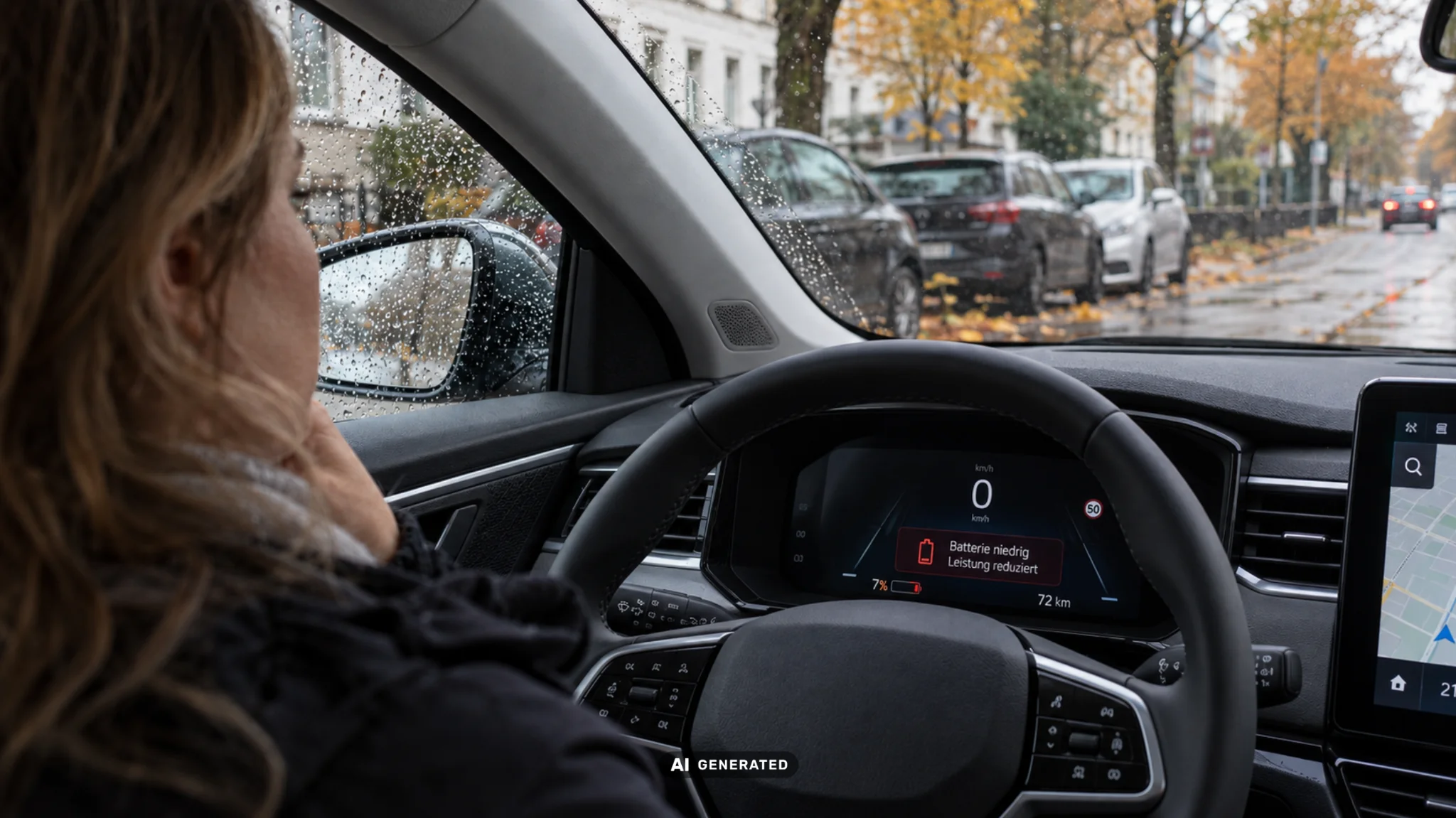
0% Battery Does Not Always Mean an Immediate Stop
The displayed battery level, also known as the State of Charge (SoC), indicates how much usable energy the vehicle calculates is still available in the battery. So, if the display shows 0% battery, this does not necessarily mean that every battery cell is completely depleted. The battery management system monitors factors such as cell voltage, temperature and power output, helping to protect the battery from critical operating conditions.
A battery buffer in an EV can mean that a small amount of energy remains available even after the display reaches zero. However, this emergency reserve does not provide a guaranteed amount of additional range. How large it is depends on factors such as the vehicle, battery condition, weather and energy consumption. True deep discharge should be avoided, as it can damage the battery.
How Much Reserve Does an EV Have When the Battery Is Empty?
There is no fixed figure. In 2025, ADAC tested six electric vehicles by driving them in controlled conditions until they came to a stop. After the display showed 0%, the vehicles still travelled around 15 to 20 kilometres before they could no longer maintain the required speed of 50 km/h. Conditions were favourable, however: mild temperatures, relatively new vehicles and an almost level route.
The EV reserve should therefore only be seen as a safety net. In cold weather, on uphill stretches or with an ageing battery, the remaining range may be lower. If you drive your EV down to empty, you should not deliberately include the emergency reserve in your route planning.
Power Limitation: What Turtle Mode Means
Before an EV battery is completely empty, many vehicles intensify their warnings. When the remaining range becomes very low, the vehicle may first limit its full acceleration capability. If the SoC drops further, more noticeable power limitation often follows: the vehicle accelerates more slowly and may only be able to reach a reduced maximum speed.
Some models display a turtle symbol at this stage. This so-called Turtle Mode indicates that very little energy remains. At the latest, you should leave the motorway and head for the nearest charging option. JOLT offers urban ultra-fast charging stations with charging power of up to 320 kW, allowing compatible vehicles to quickly add range again.
EV Battery Empty: What to Do If the Vehicle Comes to a Stop
If there is not enough energy left to reach a charging station, stop the vehicle in the safest possible place and switch on the hazard warning lights. You can find out more about your options for emergency charging on the road in our detailed guide. On roads with fast-moving traffic, you should also secure the breakdown area appropriately. On a motorway, do not attempt to push the vehicle through moving traffic yourself. Instead, contact a breakdown or recovery service.
ADAC recommends having a stranded EV transported or recovered to a charging station. Many electric vehicles must not simply be towed with the driven wheels on the road, as this can damage the electrical system. Always follow the vehicle manufacturer’s instructions. A penalty may also apply: according to ADAC, running out of battery and coming to a stop can result in a fine and a penalty point in Germany.
How to Respond When Your Remaining Range Is Low
If your battery level is getting critically low, reduce your speed, avoid hard acceleration and use Eco mode if your vehicle offers one. Heating and air conditioning also consume energy. In a traffic jam, the drivetrain itself uses relatively little energy, but climate control continues to draw power from the battery. When the SoC is very low, every kilowatt-hour matters.
It is better not to let the battery reach 0% in the first place. On longer journeys, allow some extra range for diversions, occupied charging stations or changing weather conditions, and recharge a little earlier where possible. This keeps your journey relaxed – and ensures the emergency reserve remains exactly what it is meant to be: a reserve for exceptional situations.
Ultra-fast charging
Find a JOLT station near you
Up to 360 kW – in the middle of the city, around the clock.
Find a charging station