
Fleet electrification: how to charge your fleet
Fleet electrification made simple: how companies charge their company fleet reliably and cost-effectively. Discover the right charging solution with JOLT!
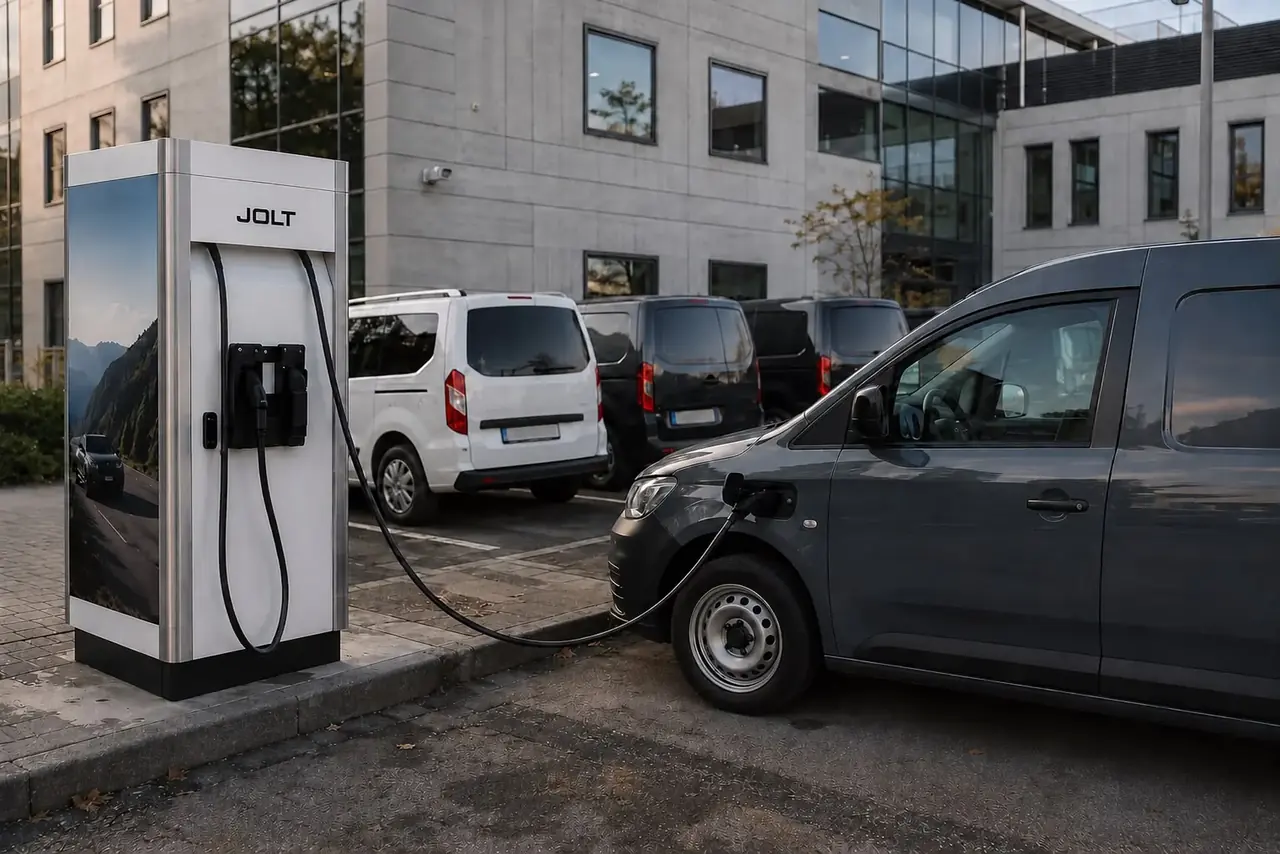
Electrifying a fleet: How businesses charge their vehicles
Switching to an electric fleet is no longer a vision of the future. Fleet electrification has become part of everyday operations at many companies. The key to success is not just the vehicle, but how you charge your company fleet reliably and economically. A strategic approach to fleet electrification keeps your fleet cost-effective and ready for use at all times.
Why more businesses are electrifying their fleets
Fleet electrification continues to gain momentum. According to Uscale's 2026 Fleet Charging study, 56% of the companies surveyed already have a long-term electrification strategy. Equally telling: the share of businesses citing high vehicle costs as an obstacle fell from 52% in 2024 to 29% in 2026. Fleet electrification is thus moving from a special project to the heart of fleet strategy.
The reasons are clear. Electric vehicles reduce operating costs per kilometre, improve the carbon footprint and strengthen a company's image. There is also growing pressure from sustainability targets and reporting obligations. Planning today gives you a measurable advantage in costs, reputation and climate goals.
It's important to know that fleet electrification isn't a one-off project but an ongoing process. In many fleets, 20 to 30% of vehicles are already suitable for an immediate switch, and that proportion is rising. This is where success is decided: only the right charging infrastructure makes the transition an economic gain.
Charging a company fleet: Three strategies at a glance
Whether the transition succeeds depends above all on one question: How can you charge your company fleet reliably without slowing down operations? Successful businesses combine three components to do so. Which one takes precedence depends on your usage patterns, vehicle downtime and routes. The right combination is at the heart of every successful fleet electrification strategy.
Depot charging at your own premises
Depot charging is the backbone of most electric fleets. Vehicles charge precisely when they are parked anyway, for example overnight at the depot. This creates predictable operations and low energy costs. It is particularly economical for fixed routes and long parking periods. Around 40 to 50% of heavy-duty trucks drive less than 300 km a day, a distance that can easily be recharged overnight. Industry forecasts suggest that around two-thirds of all charging sessions will take place at depots by 2030.
At the site, you need a suitable grid connection, carefully designed electrical installation and intelligent load management. The latter distributes the available power dynamically among all vehicles and avoids costly demand peaks. Where parking times are short or shifts change, powerful DC charging points complement the AC solution so individual vehicles can return to service quickly.
Home charging for company car drivers
Many employees with electric company cars prefer to charge at home. That appeals to businesses because it eases the burden on the depot and offers drivers convenience. Since January 2026, updated guidance from Germany's Federal Ministry of Finance has governed how businesses can reimburse home charging costs tax-free. A transparent billing system ensures that every kilowatt-hour charged is accurately allocated to the right vehicle. This keeps home charging a cost-effective part of your fleet electrification strategy.
Commercial charging in the city
Not every company fleet returns to a central site in the evening. Field service teams, sales representatives, care services and last-mile delivery vehicles move around the city all day. For them, commercial charging in the city is crucial. Public fast-charging points step in precisely where depot and home charging reach their limits: when stopping times are short, daily mileage is high and no company depot is available.
A dense, reliable network of fast chargers in the city centre fills this gap. It turns short breaks, such as a customer visit, a shopping trip or a lunch break, into valuable charging time.
Ultra-fast charging as part of fleet electrification
This is where JOLT comes in: as a charge point operator (CPO), JOLT operates ultra-fast charging stations right in the city, where your vehicles already travel. With up to 360 kW of charging power, you can add around 200 km of range in approximately ten minutes. That is often enough for half a working day of city driving.
The charging stations also have integrated battery storage. This enables ultra-fast charging from the standard low-voltage grid, with no costly, lengthy grid expansion. For your company fleet, that means high availability around the clock, seven days a week. Public charging thus becomes a reliable third pillar of your fleet electrification, complementing depot and home charging.
Keeping costs, tax benefits and funding in view
Fleet electrification is increasingly justified by total cost of ownership, not merely by purchase price. More than 40% of operators expect lower overall costs than for combustion-engine vehicles over a replacement cycle of four to seven years. Electricity usually costs significantly less per kilometer than diesel, and electric vehicles require less maintenance.
There are also tangible advantages for your company fleet:
- Through the greenhouse gas reduction quota (THG quota), the CO2 savings from your electric vehicles can be certified and sold. For commercially used vehicles, the premium counts as taxable income, and you can apply for your entire fleet.
- Depending on the date of first registration, fully electric vehicles are exempt from vehicle tax until the end of 2035.
- Funding programs for commercial charging infrastructure are available from time to time, based on charging power and grid connection requirements. Because these programs change frequently, it is best to check the current situation directly with the National Charging Infrastructure Control Centre or the relevant ministry.
Please note: tax and subsidy details depend on individual circumstances. Consult a tax adviser for definitive advice.
Five steps to an electric company fleet
Successful fleet electrification follows a clear roadmap:
- Analyse your needs: Record your vehicles' routes, daily mileage and downtime. This will show you which vehicles can be electrified right away.
- Define a charging strategy: Combine depot charging, home charging and public charging to suit your operating profiles.
- Plan the infrastructure: Think of hardware, software, electrical installation and operation as one complete system, not as a single device.
- Calculate subsidies and costs: Explore funding options alongside technical planning and base your calculations on total operating costs.
- Scale up: Start with the right vehicles and expand your electric fleet step by step.
This approach makes fleet electrification predictable, economical and future-proof.
Get your fleet electrification moving
With JOLT, your vehicles charge ultra-fast in the heart of the city, around the clock and without grid upgrades. Talk to our team and discover how commercial charging in the city can move your fleet forward!
Sources
- Uscale, Fleet Charging Study 2026, reported by LOGISTRA: logistra.de
- Geotab, proportion of vehicles that can be electrified immediately, via basicthinking: basicthinking.de
- National Charging Infrastructure Control Centre, guide "Easy charging at the depot": klimafreundliche-nutzfahrzeuge.de
- Depot charging compared, daily mileage and charging volumes, AMBA Operations: amba-operations.com
- Tax-free reimbursement of home charging costs (2026 German Federal Ministry of Finance rules), via NAVIT: navit.com
- Greenhouse gas quota 2026, amount and conditions, Finanztip: finanztip.de
- GHG bonus for company vehicles and vehicle tax exemption until the end of 2035, AUTO BILD: autobild.de
Ultra-fast charging
Find a JOLT station near you
Up to 360 kW – in the middle of the city, around the clock.
Find a charging station