
EV vs. Internal Combustion Engine
**English translation (SEO-friendly):****Compare the lifetime carbon footprint of EVs and internal combustion vehicles with the latest research, clear data, and the key factor: charging electricity. ➜ Learn more!**
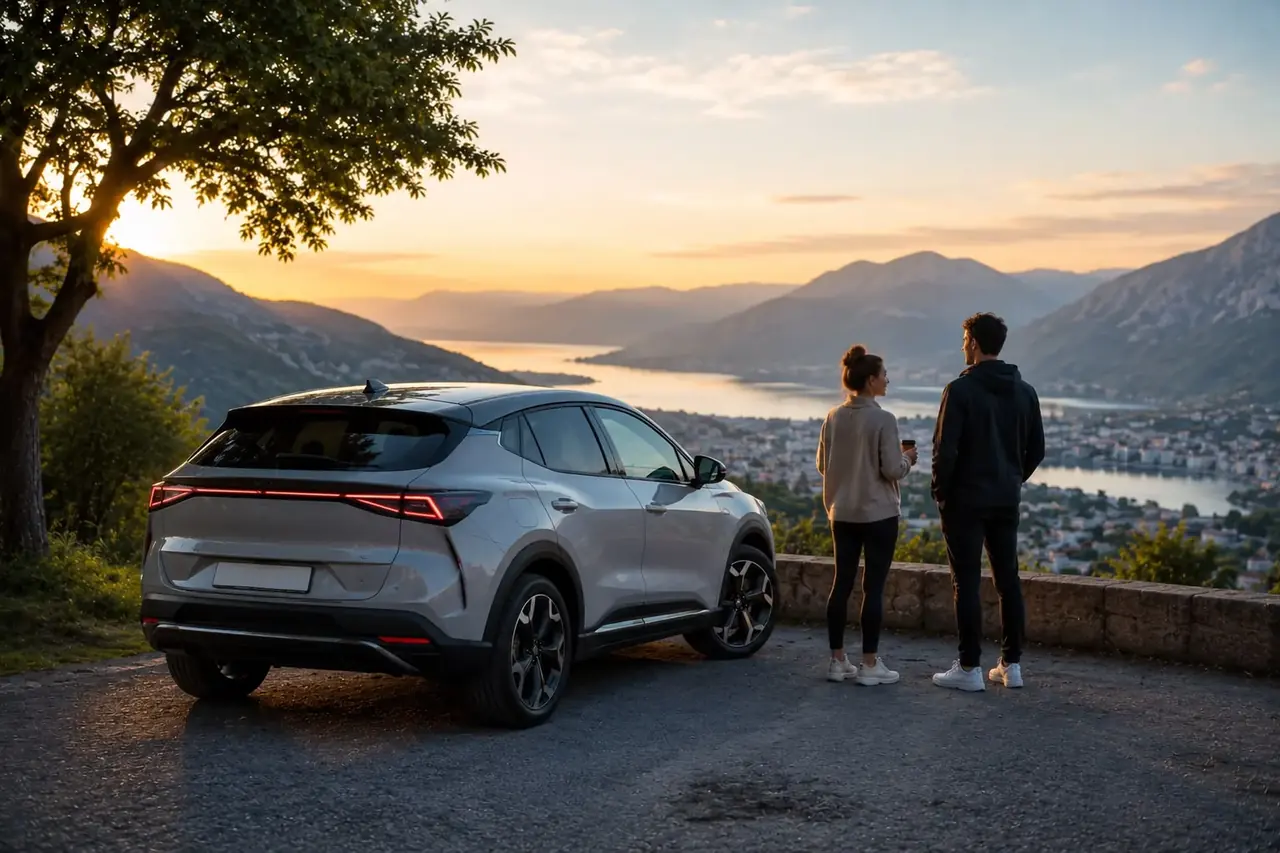
EV versus combustion car: an honest lifecycle comparison of CO₂ emissions
Few topics in electric mobility are debated as heatedly as the CO₂ footprint of electric cars versus combustion-engine cars. Critics often point to the energy-intensive production of batteries, supporters to locally emission-free driving. Anyone seeking an honest answer needs to consider the entire life cycle. That is exactly what recent studies by the International Council on Clean Transportation (ICCT), the German Environment Agency and Fraunhofer ISI do.
This article puts the figures into context and shows where you can have the greatest impact on your electric car's environmental footprint.
Why only the full lifecycle tells the whole story
A combustion-engine car visibly emits CO₂ from its exhaust, while an electric car produces no emissions where it is driven. But this direct comparison does not tell the whole story. A reliable carbon footprint for an EV accounts for every stage of the vehicle's life: manufacturing, including the battery; operation; maintenance; and disposal and recycling. Experts refer to this as a life cycle assessment or the well-to-wheel approach, which also includes the extraction and supply of fuel and electricity.
The difference is fundamental. According to Germany's Federal Ministry for Economic Affairs, around 80% of the greenhouse gas emissions from petrol and diesel cars arise during driving, when fossil fuels are burned. For electric cars, the picture shifts: the larger share arises during manufacturing, while driving produces comparatively few emissions. That very difference determines the overall outcome.
The latest figures on EV and combustion-car CO₂ emissions
One of the most comprehensive studies on this subject to date is the ICCT's life-cycle analysis for the EU, published in July 2025.
The result is clear: a newly registered battery-electric car today produces around 73% fewer greenhouse gases over its life cycle than a comparable petrol car. If it is charged exclusively with electricity from renewable sources, that advantage rises to as much as 78%. In absolute terms, an electric car produces about 63 grams of CO₂ equivalents per kilometre, compared with around 235 grams for a petrol car. Full hybrids produce about 20% less than petrol cars, putting them well behind pure electric vehicles.
For the German market, the German Environment Agency confirms this trend. A study commissioned by the agency and conducted by ifeu Heidelberg puts the climate advantage of electric cars at around 40% for vehicles registered in 2020, rising to as much as 55% for vehicles registered in 2030, provided renewable energy is expanded rapidly. Fraunhofer ISI reaches a similar conclusion: its policy brief on batteries for electric cars evaluates more than 70 scientific sources and finds a 40 to 50% reduction over the life cycle of a mid-range car.
The exact percentages depend on assumptions about vehicle class, battery size, mileage and electricity mix, and differ from study to study. The overall finding is nevertheless the same across all reputable research: the electric car performs better than the combustion-engine car in terms of its carbon footprint.
The battery's carbon debt and the break-even point
The strongest objection to electric cars concerns production. Here EVs do indeed have a disadvantage, known as their 'carbon backpack'. According to Fraunhofer ISI, producing an electric vehicle causes around 60% to 130% more greenhouse gas emissions than producing a petrol or diesel car because of battery manufacturing.
That initial disadvantage does not last long, however. According to an ICCT analysis, an electric car in Europe offsets its higher production emissions after around 17,000 kilometres of driving, usually within the first one or two years. From that break-even point, the electric car has a smaller climate impact, and its lead grows with every additional kilometre.
The myth of the particularly dirty battery persists. It largely stems from a Swedish study published in 2017, which cited up to 200 kilograms of CO₂ per kilowatt-hour of battery capacity for battery production. That figure is now considered outdated. Modern analyses estimate considerably lower values, and the amount of material needed per kilowatt-hour falls with each new generation of batteries. Recycling is another factor: valuable raw materials such as lithium, nickel and cobalt can be recovered and reused.
Why charging electricity is crucial to the environmental balance
By far the most important factor you can influence in your electric car's environmental footprint is the electricity you use to charge it. The cleaner each kilowatt-hour, the better the result. Germany's electricity mix is becoming greener every year. According to the Federal Environment Agency, renewables covered around 55% of gross electricity consumption in 2025, compared with just over 54% the year before. Under the Renewable Energy Sources Act, this share is set to rise to at least 80% by 2030.
The specific emissions factor of the German electricity mix is currently in the region of 400 grams of CO₂ equivalents per kilowatt-hour, with a clear downward trend. Charging with certified green electricity reduces this figure to a fraction and allows you to realize the electric car's full climate advantage. This is where charging infrastructure comes in: it helps determine how green an electric car really is in everyday use.
JOLT provides the solution here: our charging stations combine high charging power with integrated battery storage, enabling ultra-fast charging without costly grid upgrades. The battery also acts as an intelligent buffer, balancing the supply and demand of electricity from renewable sources in real time. With charging power of up to 360 kW, our stations add around 200 km of range in approximately 10 minutes and are available around the clock. This makes fast charging in the city centre a practical contribution to a better CO2 footprint.
What the comparison means for drivers and businesses
For private drivers, the honest answer is this: even with Germany's current electricity mix, an electric car is clearly better for the climate over its life cycle than a comparable combustion-engine car. Charging with renewable electricity at home or on the road increases that advantage further.
For businesses, fleet operators and site partners, there is also a strategic dimension. A demonstrably good carbon footprint for an EV supports ESG goals, strengthens public perception and makes locations appealing to a growing number of customers who drive electric. A reliable ultra-fast charging solution thus changes from a cost factor into a competitive advantage.
Conclusion: EV versus combustion-car CO₂ emissions
The life-cycle comparison is therefore unequivocal. The ICCT, the German Environment Agency and Fraunhofer ISI independently reach the same conclusion:
Over its entire lifetime, an electric car produces significantly fewer greenhouse gases than a combustion-engine car, despite the higher carbon footprint of its production. The electricity used for charging remains crucial. The greener each kilowatt-hour, the better the electric car's carbon balance. With ultra-fast, battery-buffered charging, JOLT makes this advantage accessible in your everyday life.
Find a charging station now and be part of the transition!
Sources
- International Council on Clean Transportation (ICCT): Life-cycle greenhouse gas emissions from passenger cars in the European Union. A 2025 update and key factors to consider. Marta Negri, Georg Bieker, July 2025. https://theicct.org/publication/electric-cars-life-cycle-analysis-emissions-europe-jul25/
- German Environment Agency (UBA): Climate advantage of electric cars confirmed. Press release 06/2024, 1 February 2024 (study conducted by ifeu Heidelberg). https://www.umweltbundesamt.de/presse/pressemitteilungen/klimavorteil-fuer-e-autos-bestaetigt
- Fraunhofer ISI: Policy brief “Batteries for electric cars: fact check and need for action, an update”, Martin Wietschel et al., 2025 (summary and reference at e-mobil BW). https://www.e-mobilbw.de/service/meldungen-detail/elektromobilitaet-im-faktencheck-policy-brief-des-fraunhofer-isi
- German Federal Environment Agency (UBA): Renewable electricity generation grows at a subdued pace. Press release 42/2025, 11 December 2025. https://www.umweltbundesamt.de/presse/pressemitteilungen/erneuerbare-stromerzeugung-verhaltenem-wachstum
- German Environment Agency (UBA): Indicator: share of renewable energy in gross electricity consumption (as of 2025). https://www.umweltbundesamt.de/indikator-anteil-erneuerbare-am
- German Environment Agency (UBA) / elektromobilitaet.nrw: The carbon footprint of electric vehicles, emission factors of the German electricity mix according to the German Environment Agency. https://www.elektromobilitaet.nrw/infos/co2-bilanz/
- German Federal Ministry for Economic Affairs and Energy (BMWE): Petrol car, diesel or EV: which is more climate-friendly? Energiewende direkt newsletter, 2025. https://energiewende.bundeswirtschaftsministerium.de/EWD/Redaktion/Newsletter/2025/02/Meldung/direkt-erfasst.html
Ultra-fast charging
Find a JOLT station near you
Up to 360 kW – in the middle of the city, around the clock.
Find a charging station