
EV consumption: city, country road or motorway?
Where does an EV use the most energy? We explain EV consumption in the city, on country roads and the motorway. => Discover JOLT today!
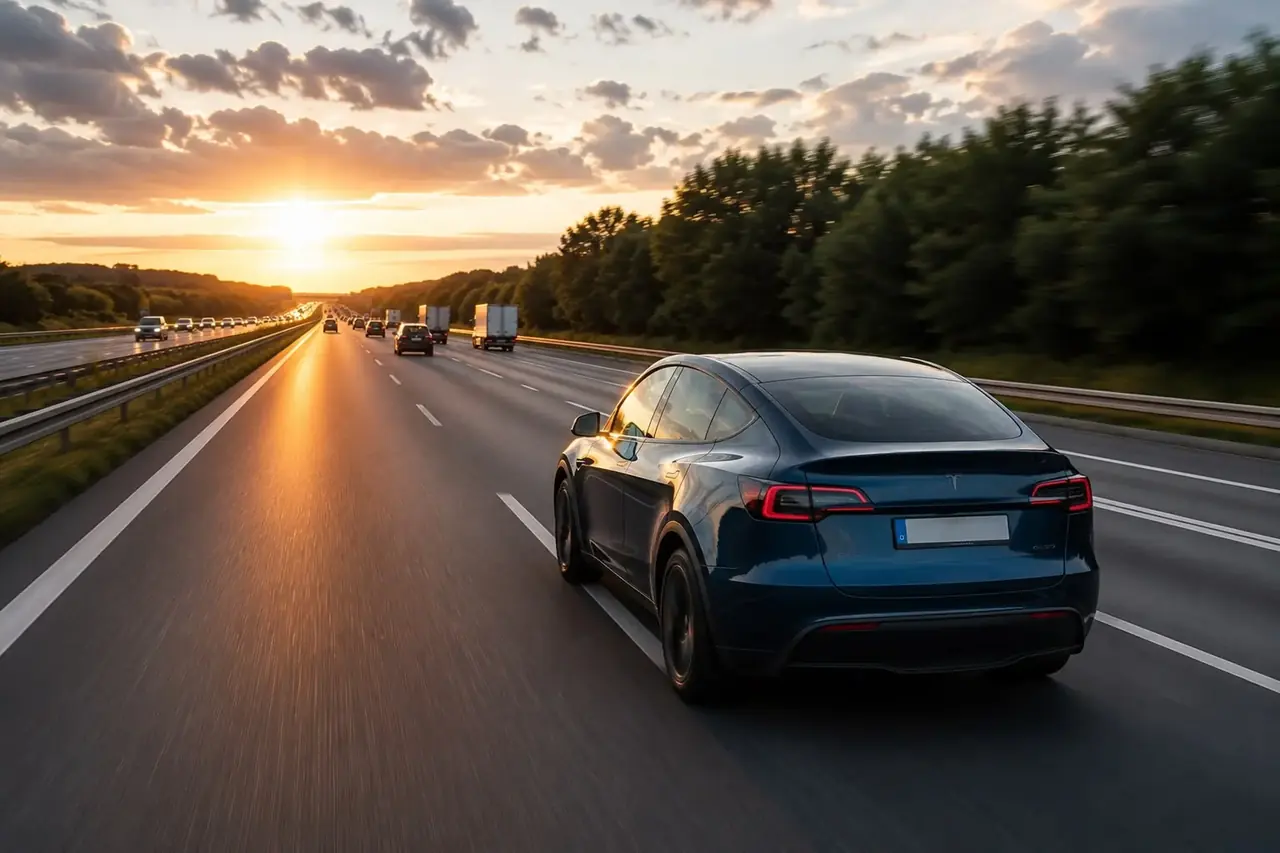
City, country road or motorway: Where does an EV use the most energy?
Many drivers know the rule of thumb for combustion-engine cars: stop-and-go city traffic uses the most fuel, while motorway driving is economical. For electric cars, the opposite is often true. Understanding where your EV really uses energy allows you to plan range, costs and charging stops much more accurately.
That's exactly what we'll examine in this article, based on the facts!
Why your route determines your EV’s energy consumption
Two physical factors determine how much energy an electric car needs per 100 kilometers. The first is aerodynamic drag. It increases with the square of speed, while the power required to overcome it increases with the cube. Double your speed and you need roughly eight times as much power just to push the air aside.
The second factor is regenerative braking. When you brake, the electric motor converts kinetic energy back into electricity and feeds it into the battery. Combustion-engine cars cannot recover energy this way, which explains why frequent braking and acceleration affect electricity consumption less than you might expect.
EV consumption in the city: efficient thanks to regenerative braking
Electric cars play to their strengths in urban areas. Low speeds keep air resistance down, and every time you brake at a traffic light or junction, the battery gains a little charge. That is why consumption is often lowest in the city, typically at around 13 to 16 kWh per 100 kilometres.
There is one exception to keep in mind: In winter, heating and climate control have a greater impact on consumption because they account for a larger share of overall energy use at low speeds. Nevertheless, city driving remains the most efficient setting for most models.
How much does an EV consume on country roads?
On rural roads, you drive in an ideal speed range. At a steady 70 to 100 km/h, air resistance remains moderate, while the energy-intensive constant acceleration of city driving falls away. Electric-car consumption on rural roads is therefore often only slightly above the urban figure, at around 15 to 18 kWh per 100 kilometres.
By driving proactively and maintaining a steady speed, you can get the best range from a single charge here. That is precisely why country roads are the unsung efficiency champions of the three road types.
And on the motorway? This is where costs rise!
On the motorway, the familiar picture reverses. Sustained high speeds cause air resistance to soar, and there is hardly any regenerative braking because you rarely slow down. As a result, EV consumption on the motorway rises significantly: at the recommended speed of 130 km/h and above, to around 20 to 30 kWh per 100 kilometres.
This clearly answers the original question: An electric car uses the most energy on the motorway. Driving at 150 km/h can almost double electricity consumption compared with city driving, noticeably reducing your range.
All the figures compared at a glance
The following overview summarizes typical estimates (depending on the model, weather and driving style):
- City: approximately 13 to 16 kWh/100 km, efficient thanks to regenerative braking and low speeds
- Rural roads: approx. 15 to 18 kWh/100 km, a good balance between speed and efficiency
- Motorway: approx. 20 to 30 kWh/100 km, highest consumption due to air resistance
The ranking is clear: electric-car energy consumption is considerably higher on the motorway than on country roads or in the city, while city driving uses the least energy.
What this means for you as an EV driver
You can put these figures to practical use every day. If you drive a lot in the city, a single charge takes you surprisingly far and saves you money. If you are planning a longer journey with a lot of motorway driving, on the other hand, factor in the electric car's higher motorway energy consumption from the outset and plan your charging stops accordingly.
Three practical tips can noticeably reduce your consumption:
- Drive smoothly: A steady speed and anticipatory braking make optimal use of regenerative braking.
- Choose your speed deliberately: Driving at 120 instead of 150 km/h on the motorway significantly extends your range.
- Charge smart: Knowing that energy consumption is higher on long journeys helps you avoid range anxiety and plan breaks without stress.
This is precisely where JOLT supports you as a charge point operator. With ultra-fast charging solutions, we bring up to 360 kW of charging power directly to city centres and add up to 200 kilometres of range to your vehicle in around 10 minutes. This lets a charging stop fit seamlessly into your day:
- Ultra-fast charging: Enough range for the rest of the day in just a few minutes.
- Right where you are: Strategically placed charging points in the heart of the city.
- Available around the clock: charge at any time of day or night.
- Effortless to use: straightforward payment options without barriers.
That way, you can turn your knowledge of EV energy consumption into more range, less stress and lower costs.
Conclusion: Speed drives consumption
Unlike a combustion-engine car, an electric car uses the least energy in the city and the most on the motorway, with country roads in between. Aerodynamic drag and regenerative braking are responsible. For you as a driver, this means the right driving style and reliable charging points let you keep your range and costs under control at all times. Would you like to recharge conveniently on the road and never worry about your electric car's energy consumption again?
Discover JOLT's ultra-fast charging network now and find a charging station near you!
Ultra-fast charging
Find a JOLT station near you
Up to 360 kW – in the middle of the city, around the clock.
Find a charging station