
EV Charging Infrastructure in Germany 2026: Figures and a Reality Check
More electric vehicles mean a greater need for places to charge – but the number of charging stations alone says little about how well the infrastructure actually works in everyday life. Germany’s EV charging infrastructure continues to expand in 2026, yet availability, charging power and regional coverage still vary considerably. Looking beyond the headline figures therefore reveals what really matters when assessing the country’s charging network.
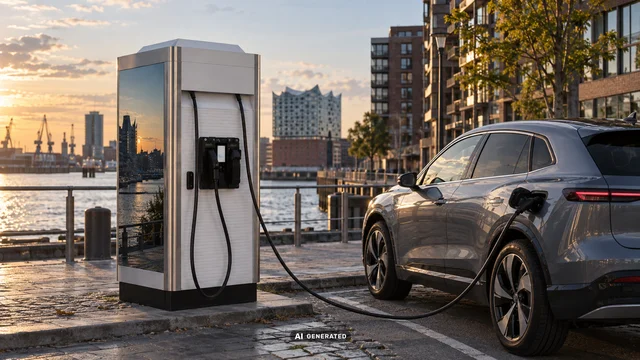
How Many Public Charging Points Are There in Germany in 2026?
The figures initially show a clear trend: as of 1 August 2026, the German Federal Network Agency (Bundesnetzagentur) recorded 156,399 standard charging points and 55,665 fast charging points. This means that more than 212,000 public charging points are registered across Germany. Together, they provide around 9.22 gigawatts of charging capacity.
However, these figures need to be put into context: the register does not capture Germany’s entire public charging infrastructure. Due to the applicable reporting procedures, additional publicly accessible charging facilities may also be available.
What the Statistics Reveal About Charging Infrastructure Expansion
Looking at the longer-term trend, Germany’s charging infrastructure is continuing to grow. According to KfW, around 200,000 public charging points were available at approximately 109,000 locations at the beginning of 2026 – around 17% more than a year earlier. At the same time, more than two million battery-electric vehicles had already been registered.
So it is not only the number of charging stations in Germany that is increasing. Demand is rising as well. Anyone assessing charging infrastructure in 2026 should therefore consider both developments together.
Why the Number of Charging Stations Alone Does Not Tell the Whole Story
Not every charging point offers the same level of performance. An AC charging point with comparatively low power serves a different purpose from a fast charging station, which can deliver significantly more energy in a short period of time.
Several factors therefore matter in everyday use: Where is the charging point located? What charging power does it offer? Is it available when you need it? Particularly for drivers without their own wallbox, the overall number of stations is only one factor in determining how convenient public charging really is.
Where Public Charging Infrastructure Still Reaches Its Limits in Everyday Use
The nationwide average masks significant regional differences. According to KfW Research, there was roughly one public charging point for every ten battery-electric vehicles at the beginning of 2026. At the same time, charging point density is higher in cities than in surrounding areas, and higher in eastern Germany than in the west.
For an effective charging network, this means new locations should not be developed simply where installation is easiest. What matters is deploying charging infrastructure strategically in places where there is genuine charging demand and where private charging options are limited.
How Modern Fast Charging Points Can Strengthen Germany’s Charging Network
Alongside the number of locations, charging speed is therefore becoming increasingly important. In cities in particular, high-powered fast charging points can help serve a large number of vehicles within a limited amount of space. They allow drivers to add meaningful range during short stops, complementing private wallboxes and slower public charging points. This is also where JOLT comes in: at a range of urban locations, we offer High Power Charging with charging power of up to 320 kW.
The reality check for Germany’s EV charging infrastructure is therefore nuanced: the network is expanding significantly, but the next stage of development will depend on choosing the right locations, providing sufficient charging power and building public charging infrastructure that reflects real-world mobility needs.
Ultra-fast charging
Find a JOLT station near you
Up to 360 kW – in the middle of the city, around the clock.
Find a charging station