
Charging infrastructure for cities
See how cities can cut CO₂, improve mobility and become more attractive with modern charging infrastructure ➤ Learn more today!
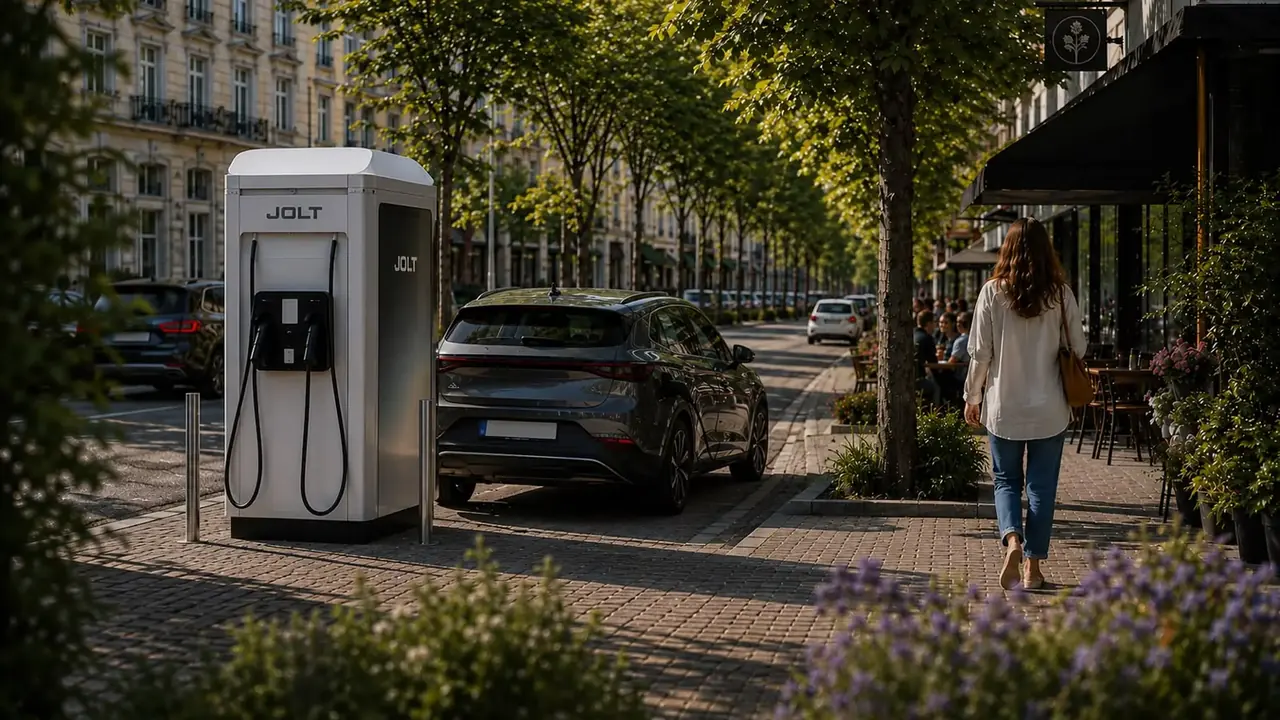
How cities can cut emissions and become more attractive with charging infrastructure
Cities face a clear challenge: enabling mobility without further compromising quality of life, the climate and public spaces. Charging infrastructure plays a central role here. When people can reliably charge their electric cars in public, switching to lower-emission vehicles becomes easier, more practical and more appealing. It gives municipalities an opportunity to rethink transport, reduce CO₂ emissions and make modern urban development visible.
Urban charging infrastructure as the key to cleaner mobility
Urban charging infrastructure lays the foundation for electric mobility to truly work in cities. Many people do not have a private parking space with their own wallbox. They depend on public charging stations that are easily accessible, simple to use and reliably available. The better the charging-point network is planned, the lower the barrier to using an electric vehicle in everyday life.
The number of charging points is not the only thing that matters. The quality of the location, charging speed and integration into existing travel routines are crucial. Charging points in central places, such as near shops, restaurants, workplaces or transport hubs, make charging a natural part of the day. This makes electric mobility feel like a practical alternative rather than an extra chore.
How cities can reduce CO₂ emissions and improve air quality
If you want to reduce traffic emissions, you need to consistently promote clean powertrains. Electric vehicles produce no exhaust emissions locally and can therefore help improve air quality in densely built-up urban areas. This effect is particularly noticeable in city centres, along main roads and in residential neighbourhoods when more combustion-engine vehicles are replaced by electric ones.
For this transition to succeed, cities must expand charging infrastructure and place it strategically where demand arises. Smart planning takes account of commuter traffic, delivery zones, residential areas, parking facilities and tourist hotspots. The result is a robust network that makes the switch easier while paving the way for sustainable mobility.
Integrating charging points intelligently into urban development
Charging infrastructure has the greatest impact when it is incorporated into urban planning at an early stage. It is not just about installing individual charging points, but about making mobility in public spaces simpler, cleaner and more reliable. To do that, cities should examine where people already park, shop, work or change modes of transport.
Such planning is particularly valuable for sustainable urban development. Public charging stations can ease pressure on residential neighbourhoods, make city centres more accessible and facilitate the switch to electric vehicles. Combined with public transport, shared mobility services, cycling and low-emission delivery logistics, they create mobility options that cause less environmental harm and improve quality of life.
Why public charging stations make cities more attractive
Highly visible public charging stations send a strong message: this city is investing in the future, climate protection and convenience. That strengthens not only the municipality's image but also its appeal to residents, visitors and local businesses. People who can charge easily are more likely to stay in the city, shop, eat out or use local services.
Charging infrastructure is increasingly important for business locations too. Companies, fleet operators, delivery services and commuters are paying more attention to whether electric mobility is practical. Municipalities that act early create a competitive advantage for their area and demonstrate readiness for future transport needs.
Expand urban charging infrastructure with JOLT
For many municipalities, the challenge lies not in the goal but in putting it into practice. Space is scarce, grid connections are complex and permits take work. It can therefore make sense to work with experienced providers. At JOLT, we help cities and municipalities build urban fast-charging infrastructure and bring electric mobility into everyday life faster.
One advantage of our modern solutions is that powerful charging points can also be installed where conventional grid expansion would be difficult or time-consuming. Anyone wishing to learn more about working together can find further information on our page for cities and municipalities. Charging infrastructure can thus become a practical means of delivering cleaner air, modern mobility and more liveable cities.
Ultra-fast charging
Find a JOLT station near you
Up to 360 kW – in the middle of the city, around the clock.
Find a charging station