
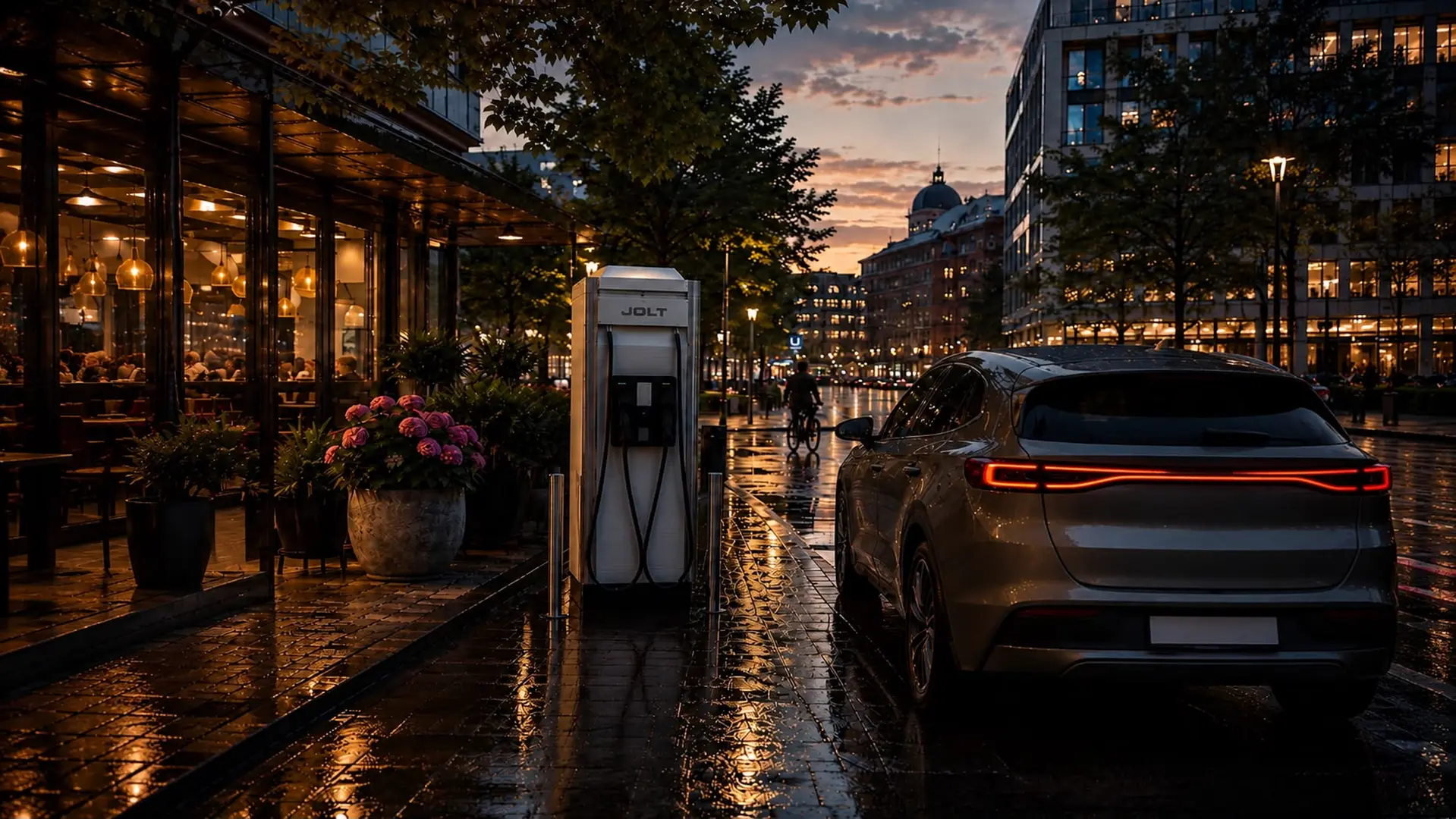
In dense city centres, every square metre is used intensively. Delivery traffic, pavements, outdoor dining areas, parking spaces, cycle lanes and public spaces all compete for the same room. At the same time, the need for fast, reliable charging options for electric vehicles is growing. This is exactly where space-saving charging stations come in: they make modern charging available in places where conventional infrastructure often reaches structural, technical or planning limits.
A charging station in a city centre needs to do more than simply provide electricity. It has to fit into existing spaces, support short dwell times and disrupt traffic flow as little as possible. In densely built-up districts, it is therefore important to look not only at the number of charging points, but also at their efficiency.
Compact fast chargers can make a decisive difference here. They reduce charging times, increase availability at each location and help make better use of limited space. For municipalities, site operators and property owners, this creates a solution that makes electromobility visible without unnecessarily blocking valuable urban space.
The biggest challenge in central locations is rarely space alone. Other factors often come into play too: limited grid connections, complex approvals, existing traffic routes and sensitive cityscapes. Good planning therefore starts with one key question: which location actually matches which charging demand?
Ideal sites are places where vehicles already stop briefly or are frequently used. These include supermarket car parks, petrol stations, multi-storey car parks, mobility hubs or spaces close to shopping streets. What matters is that the charging solution is not planned in isolation, but works as part of broader urban planning. This creates urban EV charging infrastructure that fits naturally into everyday life.
JOLT’s ChargeBox shows how powerful charging infrastructure can be delivered in limited space. It offers charging power of up to 320 kW and is designed for a minimal footprint. Thanks to its integrated battery, it can also operate with a comparatively low grid connection while still enabling ultra-fast charging.
This is particularly relevant for tight city-centre locations. Instead of large-scale conversion work or lengthy grid upgrades, a battery-buffered fast-charging solution can often be integrated more flexibly into existing sites.
Anyone planning EV charging infrastructure in a city centre should first analyse actual demand. How long do vehicles typically stay at this location? Which target groups use the site? Is there commuter traffic, shopping traffic or tourist footfall? The answers to these questions determine whether AC charging, DC charging or high power charging is the right solution.
Where space is limited, fast charging points are often especially effective because they become available again more quickly. This means a single location can support more charging sessions per day. For cities and municipalities, this is attractive because charging infrastructure not only contributes to the mobility transition, but can also support air quality, quality of life and the overall appeal of a location.
At JOLT, we support public-sector partners with projects like these, from site analysis and planning through to the operation of high-performance charging infrastructure.
Space-saving charging stations are not a side issue in electromobility. They are an important building block for city centres that need to become more sustainable and better connected. The more compact and powerful the technology, the easier it is to combine it with the many other demands placed on urban space.
For decision-makers, this means the best solution is not automatically the largest installation, but the one that fits best. When charging power, location, grid connection and usage work together, the result is EV charging infrastructure that is practical, commercially viable and ready for the future.
You are a journalist and want to reach our team? You want to sign up for press distribution list?
You need our press kit and brand assets? here is everything your might need.