
Megawatt Charging: How Ultra-Fast Charging for Electric Trucks Becomes Possible
Road freight transport is electrifying rapidly, yet heavy trucks confront the charging infrastructure with a challenge of an entirely different order. This is precisely where Megawatt Charging comes in. The new charging standard delivers power levels that exceed those of previous rapid chargers many times over, and for the first time makes ultra-fast charging of electric trucks in long-haul transport practical for everyday use.
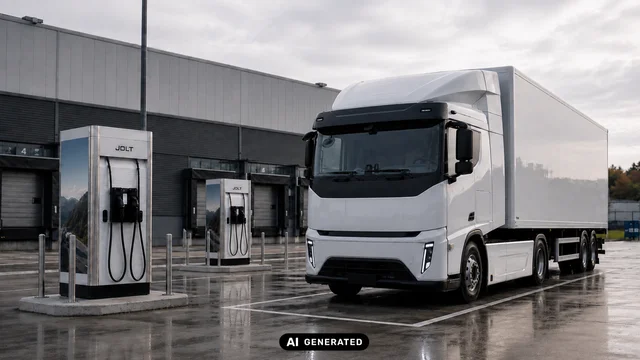
We explain how the technology works, what role the grid connection plays and why battery-buffered systems become the decisive building block in the process!
What is Megawatt Charging?
Megawatt Charging, or MCS (Megawatt Charging System) for short, is an internationally standardised rapid charging system for heavy commercial vehicles. It was developed by the Charging Interface Initiative (CharIN), a cross-industry alliance of leading vehicle and infrastructure manufacturers. Technically, the standard is designed for charging power of up to 3.75 MW, at voltages of up to 1,250 volts and currents of up to 3,000 amperes.
For comparison: today's charging stations using the Combined Charging System (CCS) deliver a maximum of around 400 kW.
To ensure these enormous amounts of energy flow safely, MCS uses a purpose-built, triangular and actively cooled charging connector. Communication between the vehicle and the charging station runs via the established ISO 15118 protocol, which enables convenience features such as Plug and Charge. Technical standardisation is progressing swiftly: the SAE published the J3271 standard in March 2025, while in parallel Ethernet was defined as a robust communication layer within the IEC 61851-23-3 standard.
MCS Charging Compared with CCS and HPC
Why is a new system needed at all? The answer lies in the physics of large batteries. A long-haul truck carries battery capacities that are many times those of a car. To fill such storage in a reasonable time, even powerful High Power Charging (HPC) is not sufficient. MCS charging delivers up to ten times the power previously available and thereby closes a gap for which the CCS connector would simply be underdimensioned.
It is worth noting that MCS does not replace HPC and CCS but complements them. For short stops during daytime operations and for depot charging, power levels between 150 and 400 kW remain central. Only in long-haul and heavy-duty transport, where tight time windows meet very large batteries, does Megawatt Charging fully play to its strengths.
Why Charging Electric Trucks with MCS Changes Long-Haul Transport
Professional drivers are subject to strict driving and rest periods. The Megawatt Charging System is aligned precisely with these requirements. The calculation is compellingly simple: if an electric truck recharges during the legally mandated 45-minute break, it can then drive for a further 4.5 hours, which is exactly the maximum permitted continuous driving time. According to estimates, charging a truck battery from 20 to 80% at an MCS charging point takes around 30 to 40 minutes.
That this is no distant vision is shown by the first milestones from practice. As early as 2023, an early MCS prototype ran at 1 MW in the NEFTON research project. In June 2026, developers at Mercedes-Benz Trucks charged an eActros 600 at full power of 1,000 kW for the first time. And at the Belgian port of Antwerp-Bruges, the charging network operator Milence opened the first publicly accessible MCS charging points with up to 1,440 kW. Charging electric trucks in the megawatt range is thus visibly leaving the laboratory phase.
The Real Challenge: Grid Connection Rather Than Charging Power
Impressive as the power figures sound, the biggest hurdle for Megawatt Charging is rarely the charging station itself. Experts consistently point to the grid connection as the actual bottleneck. A single megawatt charging point demands a connection capacity that many sites simply cannot provide. Grid expansion is certainly possible, but in practice it often takes 12 to 24 months and quickly swallows six-figure sums.
This is where a concept comes into play that JOLT has been using successfully in urban areas for years: battery buffering. A stationary buffer storage unit at the grid connection point compensates for a low connection capacity by storing energy temporarily and releasing it at high power when required. In this way, load peaks can be absorbed without the need for expensive grid extensions. Experts refer to this as battery-buffered charging or a grid booster.
Professional honesty calls for one qualification: a buffer storage unit is not a cure-all. The Fraunhofer Institute for Solar Energy Systems (ISE) points out that buffering is worthwhile above all where the connection is scarce and the load peaks are short. If high power is drawn continuously at a site, the storage ages more quickly and a stronger grid connection is often the more robust solution. In addition, the majority of truck charging still takes place at the depot: according to one study, charging power of up to 44 kW will cover the daily needs of around 63% of trucks by 2035. Megawatt Charging is therefore not a standard for every fleet, but the solution for long distances and tightly scheduled operations.
Battery-Buffered Charging: The Principle Behind Grid-Friendly High Performance
A clear word of clarification at this point: JOLT does not operate Megawatt Charging for trucks. As a charge point operator, JOLT specialises in ultra-fast charging in urban areas, with charging power of up to 320 kW for cars. The underlying operating principle nonetheless explains why battery buffering is also so relevant for MCS sites.
JOLT's charging solutions, the MerlinOne and the ChargeBox, have integrated battery storage. This allows them to be connected to the ordinary low-voltage grid and to achieve high charging power there, which elsewhere would require a costly medium-voltage upgrade. It is precisely this principle, high charging power with a limited grid connection, that scales conceptually up to the power range of Megawatt Charging. Anyone wishing to understand how grid-friendly high-power charging works in everyday use will find a clear example in JOLT's charging solutions. We support companies that want to build charging infrastructure without their own grid expansion, acting as their site partner.
Expanding the Charging Infrastructure: AFIR, the Motorway Network and Milence
The regulatory framework is set by the European AFIR regulation (Alternative Fuels Infrastructure Regulation). For heavy commercial vehicles, it prescribes publicly accessible charging sites at fixed intervals along the TEN-T core network. According to the current position, by the end of 2027 sites with high total charging power and several high-power charging points are to be available on at least half of the core network. The precise intervals and power levels are being specified on an ongoing basis in delegated acts.
In Germany, the Autobahn GmbH, together with the National Centre for Charging Infrastructure (Nationale Leitstelle Ladeinfrastruktur), is driving forward the development of a rapid truck charging network along the motorways. In parallel, the HoLa research project (high-power charging in long-haul truck transport) is gathering practical experience with Megawatt Charging in real logistics operations at several sites.
Conclusion: Megawatt Charging Makes the Electric Truck Fit for Long-Haul Transport
Megawatt Charging is the key to raising heavy electric trucks to the range and time levels of today's daily diesel routes. The technology is well advanced, the first charging points are in operation and the regulatory framework is setting the pace. The real art lies in combining high charging power with a limited grid connection. Battery-buffered systems provide a convincing answer to this, in heavy-duty transport just as much as in urban car charging.
It is precisely this grid-friendly high performance that JOLT is already bringing to cities today. Would you like to bring ultra-fast charging to your site without complicated grid expansion? Then become a JOLT site partner and help actively shape the all-electric future.
Sources
- CharIN, SAE J3271 and IEC 61851-23-3 (standardisation)
- ABB E-mobility: technical specifications and CCS comparison
- TRATON: MCS, rest break and range
- Volvo Trucks: MCS fundamentals and charging times
- Daimler Truck: eActros 600 charges at 1,000 kW
- electrive.net: Milence expansion in Germany
- TU Munich: buffer storage for megawatt charging
- Fraunhofer ISE on the relationship between grid expansion and megawatt charging
- National Centre for Charging Infrastructure: AFIR
- HoLa: high-power charging in long-haul truck transport
- JOLT Energy: Our charging solutions
Ultra-fast charging
Find a JOLT station near you
Up to 360 kW – in the middle of the city, around the clock.
Find a charging station