
Inductive charging station: Current status and outlook for wireless EV charging
Park, get out, done. No cable from the trunk, no plug, no cold fingers in winter. What has long been commonplace with smartphones is now reaching electric cars. Since mid-September 2026, wireless charging for the Porsche Cayenne Electric in Germany has been available to order. This brings the inductive charging station out of the research lab and into the private garage.
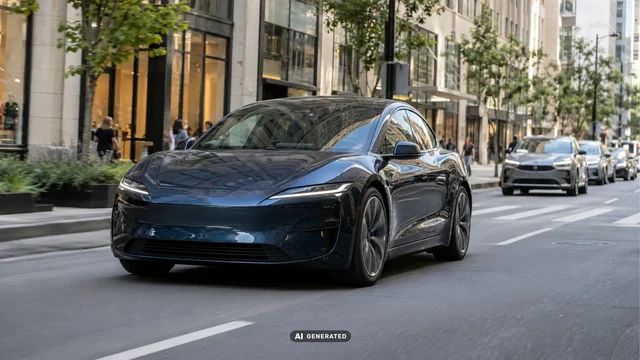
But how advanced is the technology really? How much power does it deliver, what does the convenience cost, and when will you be able to charge on the road without a cable? We have compiled the latest facts from manufacturer information, standards and research projects and show you what inductive EV charging can already do today.
What is an inductive charging station?
An inductive charging station transfers energy without physical contact between the charging equipment and the vehicle. Instead of a cable, it uses a magnetic field. A ground pad transmits the energy, while a receiver coil underneath the vehicle picks it up. The most important requirement is therefore built into the vehicle itself, because wireless charging for an electric car will not work without an integrated receiver coil.
Incidentally, when people hear the term “wireless car charging,” many initially think of the charging pad for smartphones in the center console. According to the German Commission on Radiological Protection (SSK), these Qi charging pads transfer between 5 and 15 watts. This article is about an entirely different scale: kilowatts for the vehicle battery.
How inductive EV charging works
You may already know the principle from a transformer. Alternating current flows through the transmitter coil in the ground pad, creating a magnetic field that constantly changes direction. This field induces a voltage in the vehicle’s receiver coil. The vehicle electronics then convert the current into direct current and use it to charge the battery.
Static or dynamic: two approaches to wireless charging
Experts distinguish between two variants. With static charging, the vehicle remains stationary, for example in a garage, a company parking lot or at a taxi stand. With dynamic charging, electricity is transferred while the vehicle is moving via coils embedded in the road. EVs currently use the static variant predominantly, while dynamic charging is still being tested.
Wireless car charging: the state of play in 2026
The market is still relatively small, but things are starting to move. These are the developments you should know about:
- Porsche has offered wireless charging as an optional extra for the Cayenne Electric since mid-September 2026, available to order in Germany and other European markets. The system transfers up to 11 kW. Porsche puts grid-to-battery efficiency at up to 90%.
- According to EnBW, BMW already offered the 530e iPerformance plug-in hybrid with an inductive home charging solution in 2017. This pilot solution has since been discontinued.
- Genesis, Hyundai’s premium brand, has equipped models such as the GV60 with the technology in selected markets.
- Tesla does not offer an inductive solution for its production vehicles. According to EnBW, the manufacturer is focusing its inductive charging efforts on autonomous robotaxis, which are still under development.
Standards are essential if wireless car charging is to work across different brands. The SAE J2954 standard issued by SAE International defines three power classes for passenger cars: WPT 1 with up to 3.7 kW, WPT 2 with up to 7.7 kW and WPT 3 with up to 11 kW. In Germany and Europe, the DIN EN IEC 61980 series of standards governs wireless power transfer systems for electric vehicles.
The direction of energy flow is particularly interesting for the future. The 2019 version of SAE J2954 is limited to charging from the grid to the vehicle, while energy transfer in the opposite direction is only intended to be examined at a later stage. You can find out how a car can function as an energy storage system in our article on bidirectional charging.
Inductive charging station or cable: power and efficiency
When it comes to convenience, the inductive charging station is clearly ahead. But the hard numbers deserve a closer look.
Criterion
Inductive
Wallbox with cable
JOLT fast charger
Charging power
usually around 3.6 kW at home, Porsche system up to 11 kW
usually 11 or 22 kW
up to 320 kW
Operation
simply park
plug and unplug the cable
plug and unplug the cable
Typical location
garage, parking space, pilot fleets
home, workplace
city, everyday routes, 24/7
Charging power reveals the biggest difference. At 11 kW, no more than 11 kWh can flow into the vehicle per hour, before losses are taken into account. Why power in kW and energy in kWh are two different things is explained in our article on kW, kWh and charging speed.
EnBW gives an efficiency range of around 85 to 95%. In 2019, the SSK stated that published figures for complete systems were no higher than 90% and that a plug connection is, for physical reasons, at least a few percentage points more efficient. The reason is the air gap. The magnetic field has to be continuously built up and reduced across this gap, and energy is lost in the process.
Advantages and limitations: wireless EV charging put to the test
The technology’s strengths are particularly evident in everyday use:
- Automatic charging starts when you park, without any cable or plug
- No mechanical wear on plug connections
- Lower risk of operating errors
- A strong foundation for automated parking and autonomous vehicles
At present, however, there are also clear limitations:
- Significantly lower charging power than DC fast chargers
- Slightly higher energy losses than cable-based charging
- High costs for vehicle and ground equipment
- Very little public infrastructure and no standardized billing models yet
How safe is an inductive charging station?
A strong magnetic field is created between the ground pad and the vehicle, which is why safety is a top priority. In 2019, the SSK classified the fields generated by inductive charging systems as the most critical field source associated with future automotive use in terms of potential limit-value exceedances. It recommended taking radiation protection into account from the design stage, for example by keeping the air gap as small as possible.
Manufacturers address this with several layers of protection. Porsche uses shielding plates and ferrites to prevent the magnetic field from spreading. Foreign-object detection, for example for a dropped key, and living-object detection, for example for animals, stop the charging process if a hazard is detected. According to Porsche, the limits for electromagnetic compatibility (EMC) are met by a substantial margin.
Dynamic charging: electricity straight from the road
Wireless car charging while driving takes the concept one step further. In November 2025, a pilot project was launched on the A6 motorway in the Upper Palatinate between Sulzbach-Rosenberg and Amberg-West. Over a one-kilometer section, copper coils are installed around 12 centimeters beneath the asphalt and can transfer up to 25 kW per segment. The E|MPower project is funded by the German Federal Ministry for Economic Affairs and led by Friedrich-Alexander-Universität Erlangen-Nürnberg, with the system supplied by Electreon Germany. Only authorized vehicles fitted with a special receiver can use the section, and according to ADAC, this receiver currently exists only as a prototype.
Experts are also gaining experience in public transport. Together with Electreon, EnBW is testing a charging route for electric buses in Karlsruhe, while dynamic inductive charging has been tested in regular bus operations in Balingen as part of the ELINA project since 2023. If the technology makes the leap from testing to everyday use, ADAC says it could allow for fewer charging stops and smaller batteries, reducing weight, costs and raw material consumption. However, a nationwide rollout is not yet in sight.
Outlook: Where inductive charging stations will arrive first
Wireless EV charging is unlikely to become established overnight. Instead, adoption is expected to happen gradually. Three areas of application are emerging.
At home and in the premium segment
According to an analysis by Porsche, around 75% of all charging sessions for a fully electric Porsche take place at home. This is exactly where inductive EV charging delivers its biggest convenience benefits. According to EnBW, experts expect the technology to make its initial breakthrough in the premium segment.
Taxis, buses and fleets
Vehicles with fixed periods of downtime stand to benefit in particular. The TALAKO project investigated inductive charging for electric taxis at taxi ranks. According to EnBW, operation continued at individual locations after the project ended in 2022, including in Cologne. The technology is therefore considered fundamentally viable for fleet operations, although broad scaling in public spaces has yet to materialize. For municipalities, taxi ranks and bus depots could therefore be among the first public locations where an inductive charging station makes sense.
Autonomous vehicles
A driverless robotaxi cannot plug in a cable. Porsche is already planning to combine wireless charging with automated parking, allowing the vehicle to park itself and start the charging process independently. Wireless car charging therefore becomes a logical complement to autonomous driving.
Wireless at home, ultra-fast in the city
As convenient as an inductive charging station in your garage may be, it cannot replace fast top-ups on the road. The most powerful inductive passenger-car systems available today transfer up to 11 kW. Anyone who needs extra range between appointments or does not have their own garage still depends on public fast charging.
This is exactly where JOLT comes in. As a charge point operator (CPO), JOLT brings ultra-fast charging directly into cities, with charging power of up to 320 kW and around 200 km of range in approximately 10 minutes, depending on the vehicle. Integrated battery storage enables ultra-fast charging without costly grid expansion, and the charging stations are available to you 24/7.
For businesses and municipalities, getting started remains simple. You provide the site, while JOLT plans, finances and operates the charging infrastructure. No investment of your own is required, no grid expansion is necessary, and the systems take up very little space.
Don’t want to wait until inductive charging stations become the standard? Then charge ultra-fast with JOLT today or become a location partner.
Conclusion: Convenience for the future, speed for today
In 2026, the inductive charging station has arrived as a production option, initially in the premium segment and with charging power of up to 11 kW. Standards such as SAE J2954 and DIN EN IEC 61980 are laying the groundwork for compatibility, while pilot projects on motorways and in public transport demonstrate the potential of dynamic charging. However, high costs, somewhat greater energy losses and a lack of public infrastructure are still slowing widespread adoption. Wireless EV charging therefore makes everyday life more convenient, while fast charging remains the job of high-performance fast chargers.
Sources
- ADAC: Inductive charging on the motorway, test section launched on the A6 (November 6, 2025), https://www.adac.de/news/verkehr-teststrecke-induktives-laden/
- electrive.net: Porsche Cayenne Electric now also available with wireless charging (September 16, 2026), https://www.electrive.net/2026/09/16/porsche-cayenne-electric-wireless/
- Porsche Newsroom: How does inductive charging work in the new Cayenne Electric? (November 12, 2025), https://newsroom.porsche.com/de/2025/produkte/porsche-wireless-charging-induktives-laden-cayenne-electric-40978.html
- Porsche Newsroom: Inductive charging technology in the Porsche Cayenne Electric, questions and answers (November 12, 2025), https://newsroom.porsche.com/de/2025/produkte/porsche-cayenne-electric-induktive-ladetechnologie-fragen-antworten-41077.html
- Porsche Newsroom: Cayenne Electric and Cayenne Coupé Electric press kit, Charging, https://newsroom.porsche.com/de/pressemappen/Cayenne-Electric-und-Cayenne-Coup%C3%A9-Electric/Laden.html
- Porsche Holding Newsroom: How does inductive charging work in the new Cayenne Electric? (November 14, 2025), https://www.porscheholding-newsroom.at/storys/porsche/wie-funktioniert-das-induktive-laden-des-neuen-cayenne-electric
- KÜS Newsroom: Porsche, inductive charging for the Cayenne (September 7, 2025), https://newsroom.kues.de/2025/09/07/porsche-induktives-laden-fuer-cayenne/
- EnBW Blog: Inductive charging for EVs, promising technology with great potential (April 20, 2026, updated May 11, 2026), https://www.enbw.com/blog/elektromobilitaet/laden/induktives-laden-bei-e-autos-vielversprechende-technik-mit-grossem-potenzial/
- German Commission on Radiological Protection: Electromagnetic fields in automobiles from wireless applications, inductive charging and electric driving (recommendation, June 2019), https://ssk.de/fileadmin/documents/de/2019/2019-06-27EMFAuto.pdf
- SAE International: J2954_201904, Wireless Power Transfer for Light-Duty Plug-in/Electric Vehicles and Alignment Methodology, https://saemobilus.sae.org/standards/j2954_201904-wireless-power-transfer-light-duty-plug-electric-vehicles-alignment-methodology
- Wikipedia: SAE J2954 (WPT 1 to 3 power classes), https://en.wikipedia.org/wiki/SAE_J2954
- DIN Media: DIN EN IEC 61980-1:2021-09, Wireless power transfer (WPT) systems for electric vehicles, Part 1, https://www.dinmedia.de/de/norm/din-en-iec-61980-1/342177506
- go-e Magazine: Inductive charging for electric vehicles (November 27, 2025), https://go-e.com/de-at/magazin/induktives-laden-bei-e-fahrzeugen
Ultra-fast charging
Find a JOLT station near you
Up to 360 kW – in the middle of the city, around the clock.
Find a charging station