
Increase your EV range: how to get more kilometres from every charge!
The range promised on paper and the kilometers you actually drive often diverge in everyday use. A large part of that gap, though, is in your own hands. To increase your EV range, you need neither expensive retrofitting nor sacrifice, above all just the right habits.
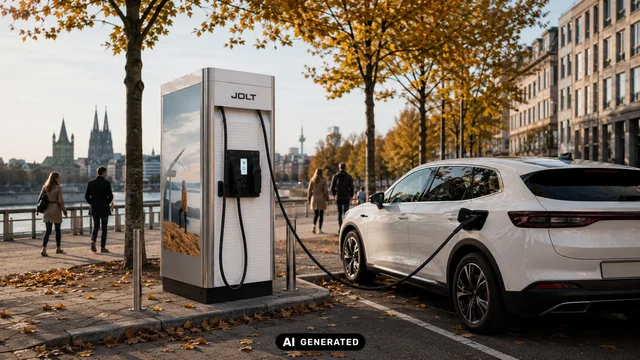
We have put together the most effective, fact-based tips to help you cut your energy consumption, drive more efficiently, and arrive at your destination more relaxed!
Why do real and stated range often differ?
The manufacturer's figure under WLTP is produced under standardised laboratory conditions and mainly serves to compare different models. On the road, by contrast, many factors act at once: speed, outside temperature, driving style, payload and the topography of the route. The ADAC explicitly points out that higher speeds and low temperatures noticeably reduce your range.
Anyone who understands these connections can counteract them in a targeted way and significantly increase their electric car's range. And if you want to drive your EV efficiently, you benefit twice over: more range and lower charging costs.
Driving your EV efficiently: steady and anticipatory on the road
The single most effective lever costs nothing: your own driving style. If you want to drive your EV efficiently, drive steadily, keep your distance and flow with the traffic instead of constantly accelerating and braking. Every braking manoeuvre you can avoid through anticipatory driving saves energy. Cruise control helps you hold a constant speed and keep consumption in check. According to the ACE, an energy-saving driving style alone can reduce consumption by up to 50%. That makes driving style the single biggest factor you can influence directly.
Easing off the pace: the biggest lever on the motorway
On the motorway, physics dominates. Aerodynamic drag grows with the square of speed, and the drive power needed to overcome it grows with the cube. This means even moderate increases in speed cost a disproportionate amount of energy. According to analyses from ADAC tests, going from 100 to 130 km/h translates into around 30% less range. The efficiency sweet spot lies at about 90 km/h. In practice, it is often enough to reduce your speed by 10 to 20 km/h to have noticeably more remaining range at the end of the leg. Anyone in a real hurry actually loses time overall, because longer charging stops become necessary.
Using regenerative braking to recover braking energy
Regenerative braking means recovery: when you slow down, the electric motor works as a generator and feeds energy back into the battery. This pays off especially in city traffic with frequent stop-and-go. The ADAC puts the possible gain at just under 20% more range on average. Many vehicles offer several levels of regenerative braking for this. On the motorway, by contrast, coasting, that is rolling with regeneration deactivated or set low, can make more sense, because less kinetic energy is lost this way. Try out which setting suits your route best.
Reducing energy consumption when heating and cooling
In winter, heating is the biggest range eater. According to AUTO BILD, a conventional electric heater can draw up to five kilowatts and, depending on the temperature, reduce the available capacity by up to a quarter. A heat pump works far more economically and, according to figures from the ACE, can increase range by up to 20%.
Heat in a targeted way, too: seat heating and steering wheel heating warm exactly where it counts and use considerably less than the cabin heater. In high summer, it is worth briefly airing the vehicle before you switch on the air conditioning. An activated Eco mode automatically adjusts power and climate control so that you save additional energy.
Preconditioning at the charging point
A real insider tip for cold and hot days alike is preconditioning. Warm or cool the cabin while the vehicle is still plugged into the charging cable. The energy for this then comes from the grid and not from the battery, which noticeably spares your range. AUTO BILD recommends keeping the preheated car warm afterwards using only the seat and steering wheel heating. Many models can be conveniently controlled for this via app or schedule. Our charging guide shows you how to make charging as efficient as possible overall.
Keeping an eye on tyre pressure, weight and aerodynamics
The classic saving tips apply to EVs too. Tyre pressure that is too low increases rolling resistance and costs range. For comfort reasons, manufacturers often state only the minimum pressure. Raising it by 0.2 bar is barely noticeable in ride comfort but lowers consumption without compromising safety. Important: savings must never come at the expense of safety. Remove unnecessary weight from the vehicle as well, because every kilo has to be accelerated.
And keep an eye on aerodynamics: roof boxes, rear carriers and bike racks increase aerodynamic drag and have a particularly strong effect on range with an EV. So fit such attachments only when you really need them.
Increasing your EV range in winter despite the cold
In winter, several effects add up at once: a cold battery works less efficiently, the heating draws extra energy, and on the motorway high aerodynamic drag comes on top. No cause for concern, because a few measures clearly cushion these losses. Park and charge the vehicle in a warmer garage or a car park where possible. Use Eco mode, preheat while it is plugged in and, if available, rely on the heat pump. In winter, always plan somewhat more conservatively and with a reserve, and your remaining range stays predictable.
Charging cleverly with JOLT: short stops, big range
Even with the most economical driving style, one simple truth remains: if you want to get further, you have to charge at some point. What matters is not whether the battery is completely full or completely empty, but a sensibly planned charging window. This is exactly where JOLT comes in. Our fast-charging stations sit in the middle of the city, are available around the clock and charge at up to 320 kW. So a short stop is enough to top up many kilometres again: in about ten minutes you recover around 200 km of range. Thanks to the integrated battery storage, this ultra-fast charging works without expensive grid expansion, reliably and at any time. That turns the charging stop into a short break instead of a test of patience.
Want to increase your EV range without losing any time? Find a JOLT charging station near you and charge ultra-fast whenever you need to.
Increasing your EV range: the key tips at a glance
- Drive steadily and anticipate the road instead of braking and accelerating often
- Ease off the pace on the motorway, because aerodynamic drag rises with the square of speed
- Use regenerative braking in city traffic and coast on the motorway
- Cut energy consumption with a heat pump, seat heating and Eco mode
- Precondition the cabin at the charging point
- Check tyre pressure and remove unnecessary weight and roof boxes
- In winter, preheat, park warm and plan with a reserve
- Plan charging stops cleverly and top up ultra-fast at JOLT
Sources
- ADAC, electric car range and efficiency: https://www.adac.de/fahrzeugwelt/magazin/e-mobilitaet/e-auto-mehr-reichweite-tipps/
- ADAC, saving energy in the city and regenerative braking: https://www.adac.de/fahrzeugwelt/magazin/e-mobilitaet/e-auto-strom-sparen-stadt/
- ADAC, range in winter (2026 test): https://www.adac.de/rund-ums-fahrzeug/elektromobilitaet/elektroauto/elektroauto-reichweite-im-winter-adac-test-2026/
- ACE, increasing electric car range: https://www.ace.de/elektromobilitaet/reichweite/elektroauto-reichweite-erhoehen/
- AUTO BILD, extending range (13 tips): https://www.autobild.de/artikel/elektroauto-strom-sparen-reichweite-verlaengern-tipps-20286413.html
Ultra-fast charging
Find a JOLT station near you
Up to 360 kW – in the middle of the city, around the clock.
Find a charging station