
German EV grant 2026: Who gets up to €6,000
Since 1 January 2026, the German government has once again been rewarding the switch to an electric car with real cash. The new 2026 EV grant is aimed squarely at households on low and middle incomes, paying up to €6,000 towards the purchase or lease of a new electric car. Who benefits, which requirements apply and how you apply for the premium: read on for the essentials at a glance.
What is behind the new EV grant 2026?
After the Umweltbonus (the previous purchase incentive) came to an end, the German government is following up with a new, means-tested programme. In total, around three billion euros are available, which the German Federal Ministry for the Environment says is enough for roughly 800,000 vehicles over the next three to four years. Unlike its predecessor, not everyone receives the same amount: the size of the electric car grant depends on income, the number of children and the vehicle type.
The purchase premium applies retroactively to new vehicles first registered in Germany since 1 January 2026. Both purchase and leasing qualify. This means the 2026 EV premium noticeably lowers the barrier to buying, especially when combined with lower electricity costs instead of petrol costs and the extended vehicle tax exemption.
Which vehicles are eligible?
Funding is available for new vehicles in EU class M1 registered for the first time in Germany, a category that covers passenger cars and most motorhomes under 3.5 tonnes. Eligible vehicles are:
- battery electric vehicles (BEVs)
- plug-in hybrids (PHEVs)
- electric vehicles with a range extender (REEVs)
- fuel cell vehicles, which qualify for the same rates as pure electric cars
Used vehicles are expressly not eligible, even if they have barely been driven. What counts is always the date of first registration, not the order date.
Plug-in hybrids and range extenders are subject to additional climate requirements. Vehicles registered between 1 January 2026 and 30 June 2027 must either emit no more than 60 grams of CO₂ per kilometre or offer an electric range of at least 80 kilometres.
Requirements: Who receives the german 2026 EV grant
The central requirement is income. Applications are open to private individuals of legal age whose main residence is in Germany and in whose name the eligible new vehicle is registered. The taxable household income may be no more than €80,000 per year (Source: ADAC).
For families, this threshold rises: for each child under 18 it increases by €5,000, so up to €90,000 for a maximum of two children. What matters is the average of the two most recent tax assessments, which may be no more than three calendar years old. In the case of marriage, a registered civil partnership or a cohabiting relationship, the incomes of both partners are added together.
Further requirements at a glance:
- Self-employed people can apply only as private individuals; the vehicle must not form part of business assets.
- The premium is available once per person, with a maximum of two applications per household.
- The vehicle must be kept for at least 36 months from first registration.
Pensioners can benefit too, but may need to submit a tax return voluntarily and retrospectively so that the tax office can produce the necessary tax assessments.
How much is the purchase premium?
The grant is made up of a base amount plus several top-ups. For pure electric cars, funding starts at a minimum of €3,000; for plug-in hybrids, at a minimum of €1,500. On top of that comes the social sliding scale: a taxable household income below €60,000 adds €1,000, and below €45,000 adds a further €1,000. For the first two children in the household, the amount rises by €500 each. This brings the total to up to €6,000 for pure electric cars and up to €4,500 for eligible plug-in hybrids.
The following overview shows the funding rates for pure electric cars:
Taxable annual household income
No minor children
One minor child
Two or more minor children
up to €45,000
€5,000
€5,500
€6,000
€45,001 to €60,000
€4,000
€4,500
€5,000
€60,001 to €80,000
€3,000
€3,500
€4,000
€80,001 to €85,000
no funding
€3,500
€4,000
€85,001 to €90,000
no funding
no funding
€4,000
The following rates apply to plug-in hybrids and vehicles with a range extender:
Taxable annual household income
No minor children
One minor child
Two or more minor children
up to €45,000
€3,500
€4,000
€4,500
€45,001 to €60,000
€2,500
€3,000
€3,500
€60,001 to €80,000
€1,500
€2,000
€2,500
€80,001 to €85,000
no funding
€2,000
€2,500
€85,001 to €90,000
no funding
no funding
€2,500
Source of the funding rates: German Federal Ministry for the Environment.
Working out your EV grant 2026: the right calculator
Would you rather not read your personal grant laboriously off a table? Then a calculator for the 2026 EV grant is the quickest route to an answer. You enter just three details: the vehicle type (pure electric car or plug-in hybrid), your taxable annual household income and the number of your children under 18. From these, the calculator works out your likely grant amount in seconds.
Among others, the ADAC offers a free EV grant calculator. If you lease, you then transfer the calculated amount into a leasing calculator and see straight away how much the premium reduces your monthly rate.
How to apply for support in 2026
You have been able to apply for the premium online since 19 May 2026 at the Federal Office for Economic Affairs and Export Control (BAFA) via the Förderzentrale Deutschland. An application is only possible after the vehicle's first registration and must be submitted no later than twelve months afterwards. Backdated applications for vehicles registered since 1 January 2026 are expressly permitted.
Here is how the process works step by step:
- Register the vehicle in your name for the first time.
- Submit the funding application via the electronic application form on the Förderzentrale Deutschland.
- Authenticate yourself using BundID (ID card with online function and PIN) or an ELSTER certificate.
- Upload all the required documents in full.
- Wait for BAFA to review your application. If the outcome is positive, the grant is transferred to your account.
Applications are processed in the order in which the complete documents arrive. BAFA cannot process incomplete applications, so careful preparation pays off.
Which documents do you need?
Have the following evidence ready for your application:
- the Vehicle Identification Number (VIN)
- the two most recent tax assessments, no more than three years old
- for the child bonus: proof of child benefit from the family benefits office
- for plug-in hybrids: the EU Certificate of Conformity as proof of an electric range of at least 80 kilometres
For digital authentication you need a BundID account or an ELSTER certificate. The BAFA hotline can help if you have any questions.
Extra bonus: You keep saving on vehicle tax
A second advantage comes on top of the purchase premium and makes every EV purchase more attractive: pure electric cars remain exempt from vehicle tax until 31 December 2035, for a maximum of ten years from first registration. This exemption applies to vehicles first registered by the end of 2030. Across the whole ownership period, this adds up to another noticeable saving.
After the grant: Quickly topped up on the go
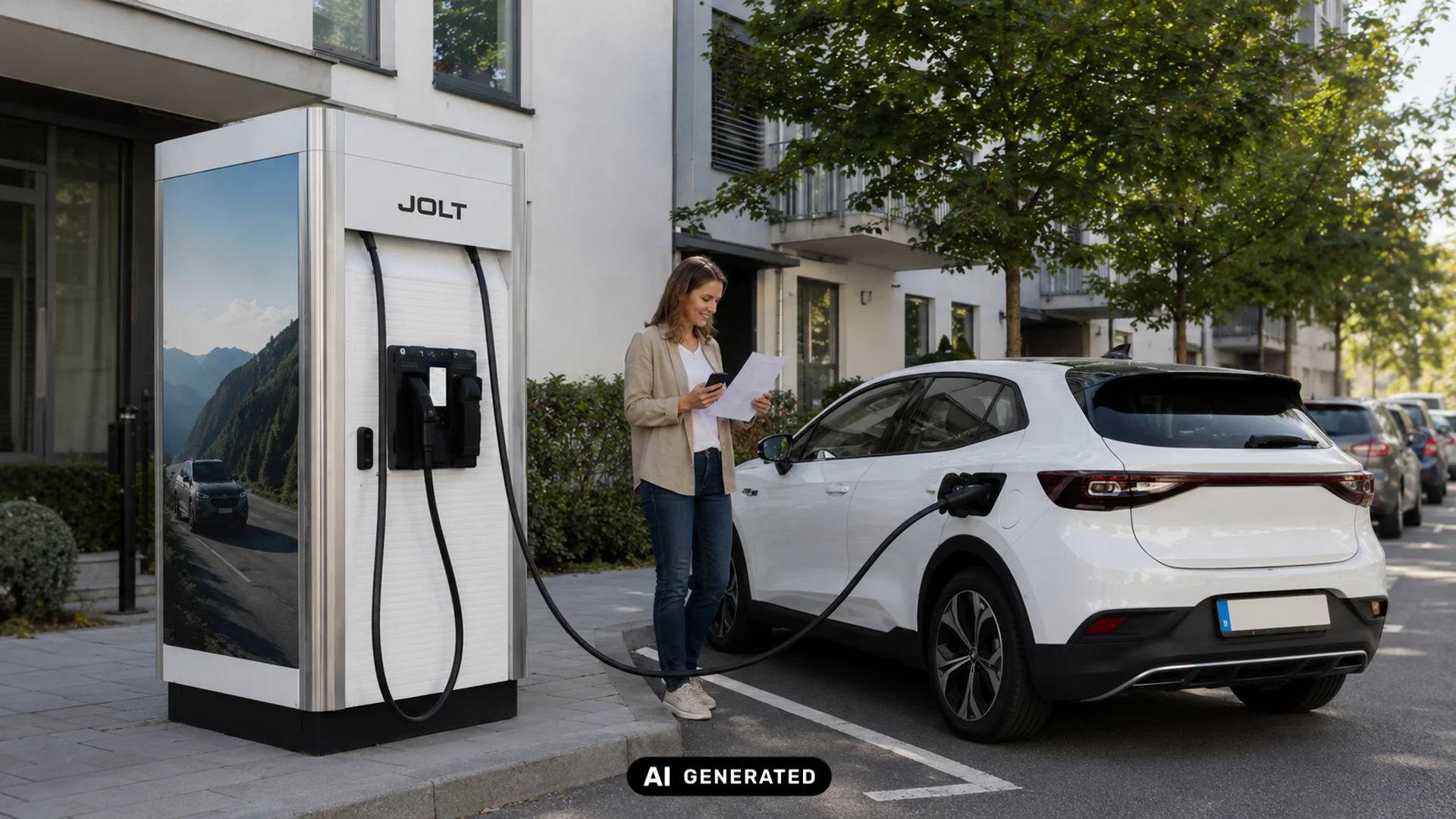
Thanks to the 2026 EV grant, a new electric car is more within reach than ever. For the switch to convince in everyday life too, reliable charging matters, especially in the city. And this is where JOLT comes in: our ultra-fast charging stations deliver up to 320 kW charging power and put approximately 200 km of range back into the vehicle in around 10 minutes.
This is made possible by integrated battery storage, which enables ultra-fast charging without costly grid extension and fits seamlessly into inner-city locations. Our charging points are available 24/7, so a charging stop slots neatly into your day. In short: you secure the grant, and we make sure you are quickly back on the road!
Find a charging station near you now!
Conclusion: Apply now and get started!
The 2026 EV grant makes switching to an electric car financially worthwhile for many households for the first time. Up to €6,000 for pure electric cars and up to €4,500 for plug-in hybrids, tiered by income and children, combined with the vehicle tax exemption extended to 2035: anyone already planning a new car should check the premium, work out their grant with the calculator and submit the application to BAFA in good time.
Sources
- ADAC: EV grant 2026 (as of 15 July 2026)
- Verbraucherzentrale: 2026 EV premium
- ACE: EV grant 2026
- Federal Ministry for the Environment: funding programme for electric cars
- BAFA: EV grant at a glance
- Förderzentrale Deutschland: application portal
(Please note that figures can change quickly and that, despite our thorough fact-checking, errors may occur. Whether you are entitled to funding, and how much you ultimately receive, still depends on the decisions of the responsible German federal authorities.)
Ultra-fast charging
Find a JOLT station near you
Up to 360 kW – in the middle of the city, around the clock.
Find a charging station